How a Pencil Eraser Is Attached
By Object Index Editorial TeamPublished Last reviewed
- Common name
- How a Pencil Eraser Is Attached
- Category
- Kitchen & Table
- Also called
- ferrule, pencil cap eraser, eraser tip, rubber tip
- Typical materials
- aluminium or brass ferrule, synthetic rubber eraser, styrene-butadiene rubber, cedar wood barrel
- What it does
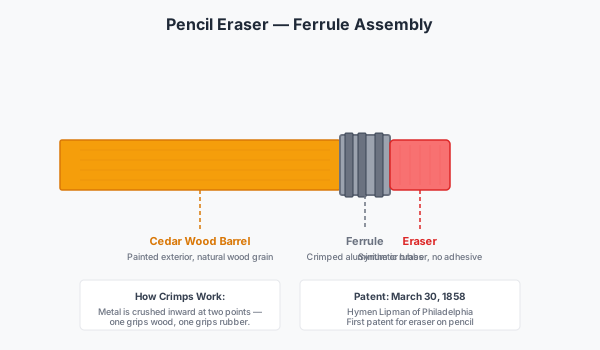
- The ferrule — a crimped metal band — holds the eraser firmly against the end of the pencil by gripping both the wooden barrel and the rubber, so you can flip the pencil and erase without switching tools.
- Last reviewed
- 2026-08-21
Direct answer
The eraser on the end of a pencil is held in place by a small metal band called a ferrule. The ferrule is a short, hollow cylinder — usually made of aluminium or brass — that is crimped (compressed) around both the wooden barrel of the pencil and the rubber eraser insert. Two sets of crimps do the work: one set bites into the wood to lock the ferrule to the pencil, and the other set bites into the rubber to hold the eraser in place. The result is a single, permanent assembly that lets you write with one end and erase with the other.
The ferrule
The word “ferrule” comes from the Latin viriola, meaning “small bracelet,” influenced by ferrum, meaning “iron.” In the context of pencils, the ferrule is a cylindrical sleeve, typically about 10 to 12 millimetres long, made from thin aluminium or brass sheet metal. It is formed into a tube, slipped over the end of the pencil, and then crushed inward by a crimping machine at two or three points along its length.
The crimps are not random — they are precisely placed. The crimps closest to the pencil body compress the ferrule into the wood grain, creating a friction fit that resists pulling and twisting. The crimps closest to the eraser compress the ferrule into the rubber, holding the eraser insert against the flat end of the pencil. Between the two sets of crimps, the ferrule remains slightly loose, which allows a small amount of flex that absorbs the impact of erasing without cracking the wood.
The eraser insert
The eraser itself is a small cylinder of rubber, typically about 6 to 8 millimetres in diameter and 10 to 15 millimetres long. It is not glued to the pencil — the ferrule’s crimps provide all the holding force. The rubber is usually a synthetic compound (often styrene-butadiene rubber with mineral fillers and a small amount of abrasive like pumice) that is firm enough to stay attached under pressure but soft enough to abrade away graphite marks without tearing the paper.
The eraser’s pink colour is traditional but not functional — it comes from the iron oxide pigment originally added to natural rubber compounds. Modern erasers come in many colours, but pink remains the most common on standard pencils.
Why pencils have erasers at all
Before 1858, pencils did not have attached erasers. People carried separate rubber blocks or used breadcrumbs to remove graphite marks. On March 30, 1858, Hymen Lipman of Philadelphia received the first patent for attaching an eraser to the end of a pencil. The patent was later invalidated on the grounds that it was simply a combination of two existing devices rather than a new invention, but the idea had already caught on. By the late 19th century, the ferrule-mounted eraser was a standard feature on American pencils.
The timing was not accidental. Charles Goodyear’s discovery of vulcanisation in 1839 had made rubber durable and affordable, and the expanding American school system created demand for a convenient all-in-one writing tool. The eraser-tipped pencil was a natural product of both developments.
Not all pencils have erasers
Many professional and artistic pencils — including most drafting pencils, high-end drawing pencils, and nearly all European-made wooden pencils — do not carry erasers. The reasons are practical: the ferrule adds weight to the end of the pencil, which changes its balance; the eraser is generally inferior to a dedicated block eraser; and the metal ferrule can scratch drawing surfaces. Artists and drafters typically prefer to choose their own eraser type for the task at hand.
Cheap pencils, student pencils, and the classic yellow No. 2 pencil almost always include erasers because the convenience of a built-in eraser outweighs the quality compromise for everyday writing.
Cap erasers
Before the ferrule-mounted eraser became standard, the most common way to attach an eraser to a pencil was the cap eraser — a small rubber cylinder that slipped over the unsharpened end of the pencil by friction alone. Cap erasers are still sold today as inexpensive replacements and are popular with people who prefer to keep their pencils unweighted. They are held on only by the grip of the rubber against the wood, so they can fall off easily — a limitation that the ferrule was specifically designed to solve.
A brief history
The pencil itself dates to the 16th century, when graphite was discovered in Borrowdale, England, and encased in wood for use as a writing instrument. For nearly 300 years, pencils remained simple sticks of graphite in wood — no ferrule, no eraser, no paint. The addition of the ferrule and eraser in the mid-19th century transformed the pencil from a single-purpose tool into a two-in-one instrument.
The modern pencil ferrule is almost unchanged from its 19th-century ancestor: a crimped aluminium or brass sleeve joining wood to rubber. The manufacturing process is highly automated — a pencil blank is cut, the ferrule is slipped on, the eraser is inserted, and the whole assembly is crimped in a single pass through a machine that can process hundreds of pencils per minute.
Common misconceptions
“The eraser is glued to the pencil.” It is held entirely by the ferrule’s crimps — no adhesive is used. “The ferrule is just decorative.” It is a structural component that must withstand repeated erasing forces without loosening. “All pencil erasers are the same rubber.” Eraser compounds vary widely — from hard, pumice-filled cap erasers to soft, vinyl artist erasers — and the eraser on a pencil is usually a compromise between durability and effectiveness. “You should erase by rubbing back and forth.” The eraser is designed to lift graphite by rolling it off the paper surface; rubbing back and forth can drive graphite deeper into the paper fibres and tear the page.
This entry is part of the kitchen & table category. For how this site verifies facts like these, see the method page, and for more stationery vocabulary, try the glossary.
The historical and mechanical details in this entry were checked against the cited references on 21 August 2026. Corrections are welcome through the contact page.
Sources
- Wikipedia — Eraseraccessed 2026-08-21
- Wikipedia — Ferruleaccessed 2026-08-21
Spotted a mistake? Tell us about it and we will correct the entry.