How a Ratchet Mechanism Works Inside a Socket Wrench
By Object Index Editorial TeamPublished Last reviewed
- Common name
- How a Ratchet Mechanism Works Inside a Socket Wrench
- Category
- Fasteners & Closures
- Also called
- ratchet wrench, socket ratchet, speed wrench, click wrench
- Typical materials
- chrome-vanadium steel gear, hardened steel pawl, steel spring, chrome-plated housing
- What it does
- A ratchet lets you turn a fastener in one direction while freely rotating in the other, so you can tighten or loosen a bolt without removing the wrench between strokes.
- Last reviewed
- 2026-08-21
Direct answer
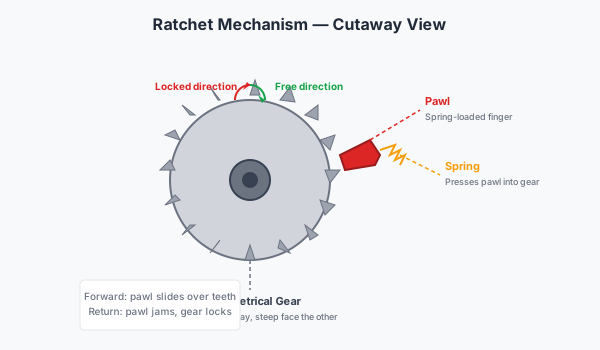
A ratchet mechanism works by combining two parts: a gear with asymmetrical teeth and a spring-loaded finger called a pawl. The teeth are shaped so that the pawl slides easily over them in one direction but catches against them in the other. In a socket wrench, this means you can swing the handle back and forth — the forward stroke turns the bolt, and the return stroke silently clicks as the pawl rides over the teeth without moving the fastener. The result is continuous tightening or loosening without ever lifting the wrench off the bolt.
The gear
The gear at the heart of a ratchet is a flat disc with a ring of teeth cut around its edge. Each tooth has a gentle slope on one side and a steep, nearly vertical face on the other. This asymmetry is the entire secret: the gentle slope lets the pawl滑过 in the free direction, while the steep face stops it dead in the locked direction.
Most socket wrenches use between 30 and 80 teeth. A higher tooth count means a smaller angle between teeth, which in turn means the wrench needs less swing arc to engage the next tooth. In a tight engine bay where the handle can only move 10 or 15 degrees, a 72-tooth ratchet (one tooth every 5 degrees) is far more useful than a 36-tooth one (one tooth every 10 degrees).
The pawl
The pawl is a small, hardened steel finger pivoted inside the ratchet housing and pressed against the gear by a spring. When the gear rotates in the free direction, the pawl slides up the gentle slope of each tooth and drops into the next valley with an audible click. When the gear tries to rotate in the locked direction, the pawl jams against the steep face of the tooth and cannot move further — the gear, the pawl, and the housing become a solid unit, and the handle’s force transfers directly to the fastener.
The spring that presses the pawl against the gear must be strong enough to keep the pawl seated during the return stroke but not so strong that it creates excessive drag. Most ratchets balance this by using a small coil spring or a flat spring behind the pawl.
The direction switch
Many socket wrenches include a small lever or dial on the back of the ratchet head that reverses the direction of operation. Internally, this switch moves the pawl so that it engages the steep face of the tooth on the opposite side. In one position the wrench locks when you push the handle forward; in the other it locks when you pull it back. Some ratchets achieve this with two pawls that alternate, while simpler designs use a single pawl that can be flipped between two positions.
Backlash
Because the pawl can only stop motion at discrete tooth boundaries, a ratchet does allow a small amount of backward movement — called backlash — equal to the spacing between teeth. In a 72-tooth ratchet, this backlash is roughly 5 degrees of handle rotation, which translates to almost imperceptible movement at the fastener. In applications where backlash must be minimised, such as precision assembly, smooth-surface ratchets with a high-friction contact (sometimes rubber) replace the toothed gear entirely. The pawl presses against the smooth surface at an angle, and any backward motion causes it to jam, reducing backlash to nearly zero.
Where ratchets appear
The ratchet-and-pawl principle is not limited to socket wrenches. It appears in cable ties (the locking ladder inside the strap is a linear ratchet), seatbelt retractors, handcuffs, bicycle freewheels, jack stands, tie-down straps, and even roller coaster anti-rollback devices. In every case the function is the same: allow motion in one direction, prevent it in the other.
In a socket wrench specifically, the ratchet is paired with a square drive — a small, protruding square post that fits into the back of a socket. The socket itself is a replaceable sleeve with a hexagonal or 12-point interior that matches the bolt head. This modular system means one ratchet handle can drive dozens of different socket sizes.
A brief history
The ratchet principle has been used in clocks and watches for centuries, where the escapement mechanism regulates the release of energy from the mainspring. The application to hand tools came later. The ratcheting socket wrench as we know it was patented in the early 20th century, building on the earlier development of interchangeable socket sets. The modern design — a enclosed head with a selectable pawl, a square drive, and a chrome-vanadium body — was standardised by the mid-20th century and remains essentially unchanged today.
Common misconceptions
“A ratchet is the same as a torque wrench.” A ratchet allows free rotation in one direction; a torque wrench measures and limits the torque applied to a fastener. They are different tools, though some torque wrenches incorporate ratcheting mechanisms. “More teeth always means a better ratchet.” Higher tooth counts reduce the swing arc needed, but each tooth is smaller and potentially weaker. For heavy-duty work, a lower tooth count with larger, stronger teeth may be more durable. “The clicking sound means something is wrong.” The click is the pawl dropping into the next tooth valley during the return stroke — it is normal and expected. “You should hold the ratchet head while turning.” Gripping the head can inadvertently shift the direction switch; hold the handle only.
This entry is part of the fasteners & closures category. For how this site verifies facts like these, see the method page, and for more tool vocabulary, try the glossary.
The mechanical explanations in this entry were checked against the cited references on 21 August 2026. Corrections are welcome through the contact page.
Sources
- Wikipedia — Ratchet (device)accessed 2026-08-21
- Britannica — Ratchetaccessed 2026-08-21
Spotted a mistake? Tell us about it and we will correct the entry.