How Scissors Turn Squeezing Into Cutting
By Object Index Editorial TeamPublished Last reviewed
- Common name
- How Scissors Turn Squeezing Into Cutting
- Category
- Kitchen & Table
- Also called
- shears, clippers, snips
- Typical materials
- stainless steel blades, carbon steel blades, hardened tool steel, plastic or rubber handle grips
- What it does
- Scissors convert a squeezing force into a shearing action by sliding two sharpened blades past each other along a shared pivot, cutting material caught between them.
- Last reviewed
- 2026-08-21
Direct answer
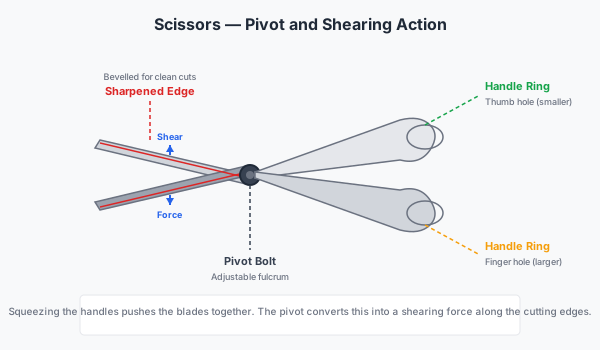
Scissors turn squeezing into cutting by using a pivot bolt as a fulcrum. When you close the handles, the two blades rotate toward each other along this pivot. Each blade has a sharpened edge that slides past the other blade’s edge — they do not meet head-on like a knife chopping, but instead glide past each other like two razor edges crossing. The material caught between the blades is severed by shearing: the combined force of both edges sliding in opposite directions creates a cut that is far more efficient than either blade could achieve alone.
The pivot
The pivot is a screw or bolt that passes through both blades at their crossing point. It holds the two halves of the scissors together while allowing them to rotate freely. The tightness of this pivot matters enormously: too loose and the blades wobble apart, letting material slip between them instead of being cut; too tight and the friction makes the scissors difficult to open and close. Most scissors allow you to adjust the pivot tension with a screwdriver, and the ideal tightness is a balance — firm enough that the blades stay in contact along their entire cutting length, but loose enough that the handles close smoothly.
The pivot’s position along the blade determines the mechanical advantage. A pivot closer to the handles and farther from the blade tips gives you more force at the cutting edge but less travel distance. Kitchen shears, which must cut through bone and tendon, typically have their pivot set farther forward than paper scissors, trading travel distance for raw cutting power.
Shear versus chop
A knife cuts by pushing a single sharp edge straight down through material — a chopping or slicing action. Scissors work differently. The two blades slide past each other at a slight angle, and the material between them is cut by shear force: two equal and opposite forces acting parallel to each other along a narrow plane. This is the same principle that lets a paper cutter slice cleanly through a stack of sheets.
Shear cutting is more efficient than chopping because the material is supported on both sides of the cut. When you chop with a knife, the material can deform away from the blade. When you剪 with scissors, the material is held between two converging edges and has nowhere to go. The result is a cleaner cut with less force.
Blade angle and sharpening
The cutting edges of scissors are bevelled — ground at an angle so that they meet at a fine line rather than a blunt surface. The bevel angle varies by purpose: hair-cutting scissors have a steeper bevel (around 40 to 50 degrees) to withstand the abrasive texture of hair, while paper scissors have a shallower bevel for a cleaner cut on thin material. Kitchen shears often have a compound bevel that combines a steep primary angle for strength with a shallow secondary angle for sharpness.
The blades are also slightly bowed — they do not lie perfectly flat against each other. This bow creates a point of contact that travels along the blade as you close the handles, like a moving fulcrum. The result is that the cut progresses smoothly from the pivot toward the tip, rather than trying to shear the entire length at once.
Handle design
The handles of scissors are longer than the blades in most designs, giving you a mechanical advantage: a small squeeze at the handles produces a larger force at the blade tips. The ratio of handle length to blade length varies by purpose. Paper scissors have roughly equal handle and blade lengths; kitchen shears and pruning shears have much longer handles to multiply force for tough materials.
Most scissors have asymmetrical handle rings — one round hole for the thumb and one elongated hole for two or three fingers. This design distributes the squeezing force across more fingers, reducing fatigue during extended use and providing better control. Left-handed scissors reverse the blade overlap so that the natural squeezing motion of a left hand pushes the blades together rather than apart.
Types of scissors
Scissors and shears exist in a wide range of configurations for different tasks:
- Paper scissors: Light blades, shallow bevel, equal handle-to-blade ratio. Designed for thin, fibrous material.
- Kitchen shears: Thick blades, steep bevel, long handles. Often include a notch for cracking bones and a serrated section for gripping.
- Hair-cutting shears: Precision-ground blades with a specific bevel angle, very tight pivot, and offset handles for ergonomic cutting.
- Fabric shears: Long blades with a bent handle that lets the lower blade rest flat on the cutting surface, keeping fabric from lifting.
- Pruning shears: Bypass or anvil designs with spring-loaded handles, built for cutting branches and stems.
A brief history
Scissors are one of the oldest hand tools. Spring scissors — two blades connected by a C-shaped spring strip — were used in ancient Egypt and Rome, and examples dating to the 2nd century AD have been found at Roman settlements. These early scissors relied on the spring to push the blades open after each cut.
Pivoted scissors, the design we use today, were not manufactured in large numbers until 1761, when Robert Hinchliffe of Sheffield, England, produced the first pair made from hardened and polished cast steel. His innovation was not the pivot itself — which had existed for centuries — but the material and the manufacturing process that made consistent, durable scissors affordable. The city of Sheffield became the centre of English scissor production, and the craft spread to Solingen in Germany and Thiers in France, both of which remain important scissor-making regions today.
Common misconceptions
“Scissors and shears are the same thing.” Shears are generally larger, with longer handles and heavier blades designed for tough materials. The terms overlap but are not identical. “Left-handed scissors just have the handle rings swapped.” The blades themselves are reversed — the upper blade is on the right side so that the natural squeezing motion of a left hand pushes the cutting edges together. Swapping only the handles makes left-handed cutting worse. “A dull scissors can be fixed by tightening the pivot.” A tight pivot helps the blades stay in contact, but it cannot restore a dull edge. Sharpening requires grinding the bevel to its original angle. “Scissors cut because the blades are sharp.” Sharpness matters, but the shearing action — two edges sliding past each other — is what actually severs the material. Two dull knives slid past each other can cut paper; two sharp knives pressed straight down cannot.
This entry is part of the kitchen & table category. For how this site verifies facts like these, see the method page, and for more tool vocabulary, try the glossary.
The mechanical explanations in this entry were checked against the cited references on 21 August 2026. Corrections are welcome through the contact page.
Sources
- Wikipedia — Scissorsaccessed 2026-08-21
- Wikipedia — Shear strengthaccessed 2026-08-21
Spotted a mistake? Tell us about it and we will correct the entry.