Reading the Lines on a Measuring Cup
By Object Index Editorial TeamPublished Last reviewed
- Common name
- Reading the Lines on a Measuring Cup
- Category
- Measuring & Marking
- Also called
- liquid measure, dry measure, graduated cup
- Typical materials
- borosilicate glass, polypropylene, stainless steel
- What it does
- A measuring cup uses printed or embarked lines to indicate volume, but liquid and dry ingredients are measured differently: liquids are read at eye level with the meniscus, while dry ingredients are scooped and levelled.
- Last reviewed
- 2026-08-20
Direct answer
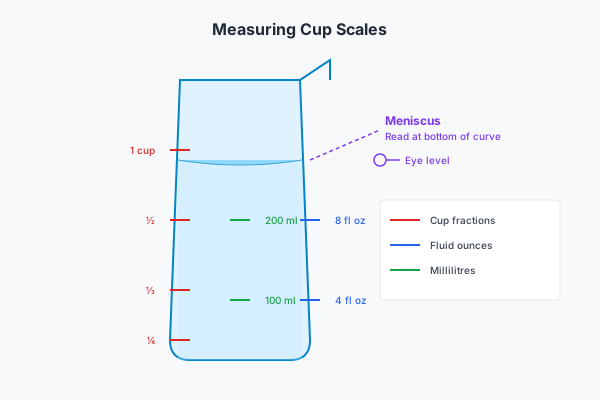
The lines on a measuring cup represent different volume units — typically cups, fractions of a cup, fluid ounces, and millilitres — all printed at the heights where that volume sits inside the vessel. But there is a critical distinction: liquid measuring cups are designed to be read with the ingredient inside, at eye level, using the bottom of the meniscus (the curved surface of the liquid). Dry measuring cups are designed to be filled to the brim and levelled off with a straight edge. The lines on a liquid cup are not the same as the fill lines on a dry cup, because a cup of flour and a cup of water occupy different volumes depending on how they are packed.
Liquid vs. dry measuring cups
A liquid measuring cup — the kind with a spout and lines on the side — is meant for water, milk, oil, and other pourable ingredients. You place it on a flat surface, crouch to eye level, and read the measurement at the bottom of the meniscus. The meniscus is the curve that forms because liquid slightly climbs the walls of the container due to surface tension. Reading from the top of the curve instead of the bottom will give you slightly too much.
A dry measuring cup — the kind that comes in a set of 1/4, 1/3, 1/2, and 1 cup — has no lines on the side. You scoop the ingredient in and level it off with a knife. The cup is designed to hold exactly the stated volume when filled flush to the rim. You cannot use a dry cup to measure liquids accurately because there is no spout and no meniscus to read.
Why the lines are at different heights
If you look carefully at a liquid measuring cup, you will notice that the 1-cup line, the 2/3-cup line, and the 1/2-cup line are not evenly spaced. That is because the cup narrows slightly towards the bottom in many designs, so equal volumes occupy different heights at different points. A well-designed cup accounts for this taper in its markings.
More importantly, a cup of all-purpose flour weighed by a kitchen scale is about 120 to 140 grams depending on whether it was spooned or scooped, while a cup of water is always about 237 grams. The volume is the same — roughly 237 millilitres — but the density changes the weight. This is why baking recipes increasingly specify weight in grams rather than volume in cups.
Reading the meniscus
The meniscus is the concave curve that forms on the surface of most liquids in a container. Water and water-based liquids climb slightly up the walls due to adhesion, creating a dip in the centre. Mercury, by contrast, forms a convex meniscus because it does not wet glass.
To read a liquid measuring cup correctly:
- Place the cup on a flat, level surface.
- Pour the liquid in slowly to avoid splashing.
- Crouch down so your eye is level with the liquid surface.
- Read the measurement at the very bottom of the curved meniscus, not at the edges where the liquid climbs the wall.
This is the same technique used in chemistry laboratories with graduated cylinders. The principle is identical — only the context changes.
Common units on a measuring cup
Most American measuring cups show:
- Cup fractions on one side: 1/4, 1/3, 1/2, 2/3, 3/4, and 1 cup
- Fluid ounces on the other side: typically 2, 4, 6, 8, 12, and 16 fl oz
- Millilitres along a third column: 50, 100, 150, 200, 250, 300, and sometimes 500 ml
The metric cup (250 ml) and the US customary cup (≈236.6 ml) are not the same size. Most American cups use the US customary cup, but some international products use the metric standard. If precision matters, check which standard your cup follows.
A brief history
Measuring cups as we know them were standardised in the early 20th century. Fannie Farmer popularised level measurements in her 1906 Boston Cooking-School Cook Book, replacing vague terms like “a teacupful” with precise, levelled cups. Before Farmer, recipes assumed the cook had intuitive knowledge of quantities. The graduated measuring cup with printed lines made baking reproducible for the first time.
Common misconceptions
“A cup of flour always weighs the same.” It does not. One cup of spooned and levelled all-purpose flour weighs about 120 grams; one cup scooped directly from the bag can weigh 140 grams or more because the flour compacts. “You can use a liquid cup for dry ingredients.” You can, but you will get less accurate results because you cannot level off a liquid cup the way you can with a dry cup. “The lines on the cup are exact.” Consumer measuring cups are typically accurate to within about 5 per cent. For laboratory precision, use a graduated cylinder or weigh ingredients by mass.
This entry is part of the measuring & marking category. For how this site verifies facts like these, see the method page, and for more measurement vocabulary, try the glossary.
The measurement claims in this entry were checked against the cited references on 20 August 2026. Corrections are welcome through the contact page.
Sources
- Washington Post — Yes, you really do need two types of measuring cupsaccessed 2026-08-20
- Wikipedia — Measuring cupaccessed 2026-08-20
Spotted a mistake? Tell us about it and we will correct the entry.