The Hidden Geometry of a Box Grater
By Object Index Editorial TeamPublished Last reviewed
- Common name
- The Hidden Geometry of a Box Grater
- Category
- Kitchen & Table
- Also called
- cheese grater, four-sided grater, box shredder
- Typical materials
- stainless steel sheet, tin-plated steel, plastic frame with steel blades
- What it does
- Each side of a box grater has a different blade pattern that produces a different particle size and shape, from coarse shreds to fine zest to flat slices.
- Last reviewed
- 2026-08-20
Direct answer
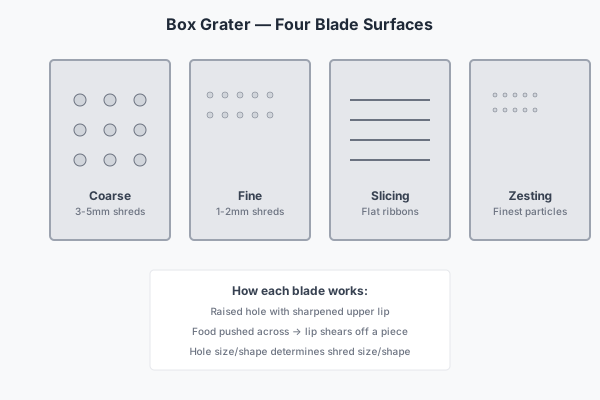
A box grater has four sides because each side carries a different blade geometry, and each geometry produces a different result. The coarse side makes thick shreds for cheese and vegetables. The fine side makes thin shreds for hard spices and zesting. The slicing side produces flat ribbons for vegetables. The zesting side, with its smallest star-shaped holes, produces the finest particles for citrus peel. The four-sided design packs four tools into one compact object.
How the blades work
Every blade on a box grater is a raised hole with a sharpened upper edge. As you push food across the surface, the sharpened lip catches the material and shears off a small piece. The size and shape of the hole determine the size and shape of the piece that falls through.
- Coarse side: Large, teardrop-shaped holes with aggressive lips. Produces thick shreds about 3 to 5 millimetres wide. Best for semi-soft cheese, carrots, and potatoes.
- Fine side: Small, round holes with finer lips. Produces thin shreds about 1 to 2 millimetres wide. Best for hard cheese, nutmeg, ginger, and chocolate.
- Slicing side: A single long, horizontal slot with a raised blade. Produces flat ribbons, essentially functioning as a manual mandoline. Best for cucumbers, zucchini, and thin slices of cheese.
- Zesting side: Tiny star-shaped or oval holes. Produces extremely fine particles, essentially pulverising citrus peel without taking the bitter white pith underneath. Best for lemon, lime, and orange zest.
The geometry behind the shred
The key insight is that the angle and height of the sharpened lip relative to the hole determines the cut. A taller, more aggressive lip takes a thicker bite, producing a coarser shred. A shorter, finer lip takes a thinner bite, producing a finer shred. The hole shape determines the cross-section of the shred: round holes produce roughly cylindrical shreds, teardrop holes produce slightly flat shreds, and the slicing slot produces flat ribbons.
This is the same principle behind industrial shredders and food processors — the cutting geometry defines the output. The box grater simply gives you four different geometries in one hand-held tool.
Hand-grated vs. machine-grated
Hand-grated food has a different texture than food processed in a food processor. When you grate by hand, the shreds are tapered — thinner at the ends and thicker in the middle — because the blade catches the food at different angles as you move it. Food processor shreds are more uniform because the food is pushed against the blade at a consistent angle.
This taper matters in cooking. Hand-grated cheese melts differently than machine-grated cheese because the varied thickness creates a mix of fast-melting thin ends and slower-melting thick centres. For dishes where melt texture matters, hand-grating is often preferred.
Cleaning and maintenance
Box graters are difficult to clean because food particles lodge in the sharp perforations. The standard approach is to soak the grater in warm soapy water immediately after use, then scrub with a stiff brush in the direction opposite to the grating motion. Running a piece of bread through the grater after use can also push out trapped cheese or vegetable fibres. Never use steel wool on a stainless steel grater, as it will scratch the blade edges and reduce their sharpness over time.
A brief history
The first graters were made of bronze and silver alloys in ancient Greece and Etruria, dating to the early first millennium BCE. They were used to grate goat cheese for making kykeon, a ritual drink. The modern box grater design emerged in the 16th century. Bartolomeo Scappi’s 1570 cookbook Opera dell’arte del cucinare includes illustrations of graters, and François Boullier is credited with developing the first modern cheese grater in 1540s France. The four-sided box design became standard in the 20th century as sheet-metal stamping technology made it cheap to produce.
Common misconceptions
“All four sides are for cheese.” They are not. Each side is designed for different food textures and desired particle sizes. “The sharp side is the ‘grating’ side and the others are secondary.” All four sides are equally intentional. Professional cooks use the slicing side as a miniature mandoline and the zesting side as a microplane substitute. “A box grater is just a cheap alternative to a food processor.” It is a different tool with different results. The hand-grated texture it produces is often preferred by chefs for specific dishes.
This entry is part of the kitchen & table category. For how this site verifies facts like these, see the method page, and for more kitchen vocabulary, try the glossary.
The mechanical explanations in this entry were checked against the cited references on 20 August 2026. Corrections are welcome through the contact page.
Sources
- Wikipedia — Grateraccessed 2026-08-20
- New York Times Wirecutter — The 4 Best Graters of 2025accessed 2026-08-20
Spotted a mistake? Tell us about it and we will correct the entry.