The Names of Common Drawer Slides
By Object Index Editorial TeamPublished Last reviewed
- Common name
- The Names of Common Drawer Slides
- Category
- Home & Repair
- Also called
- drawer runners, slide rails, drawer glides, cabinet slides
- Typical materials
- cold-rolled steel, zinc-plated steel, stainless steel, nylon rollers
- What it does
- Drawer slides are the mechanical rails that allow a drawer to move in and out of a cabinet. Different slide types offer different levels of extension, load capacity, and smoothness.
- Last reviewed
- 2026-08-20
Direct answer
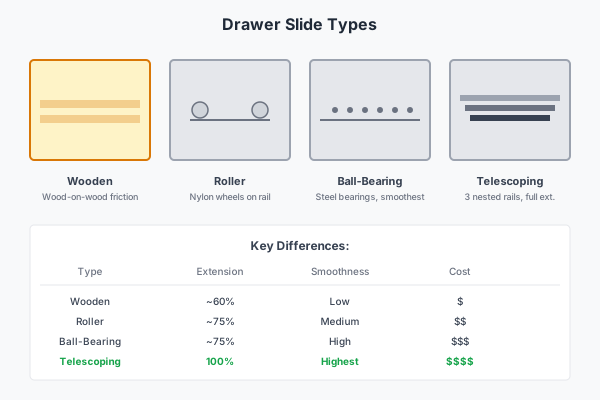
Drawer slides — also called drawer runners, glides, or rails — are the mechanical components that allow a drawer to move smoothly in and out of a cabinet. There are four main types, each with different characteristics: wooden slides (the simplest), roller slides (the most common in budget furniture), ball-bearing slides (the smoothest), and telescoping slides (the most fully extending). The name tells you the mechanism: wooden slides use wood-on-wood friction, roller slides use nylon wheels, ball-bearing slides use steel ball bearings, and telescoping slides use nested rails that extend in stages.
The four main types
Wooden slides
The oldest and simplest type. The drawer sits directly on wooden rails or runners built into the cabinet. There are no mechanical parts — just wood sliding against wood. You can improve the sliding action with wax or soap, but wooden slides have no mechanism to prevent the drawer from being pulled out accidentally. They are common in traditional furniture and are still used in some craft and heritage pieces.
Roller slides (wheel slides)
A nylon or plastic wheel is mounted on a steel bracket that attaches to the side of the drawer. A matching bracket with a rail is mounted inside the cabinet. As the drawer moves, the wheel rolls along the rail. Roller slides are inexpensive, easy to install, and handle moderate loads well. They are the most common type in modern budget furniture. The drawback is that the drawer cannot be fully extended — typically only about 75 per cent of the drawer length is accessible without the drawer tipping.
Ball-bearing slides
Instead of wheels, ball-bearing slides use a row of steel ball bearings between two nested rails. The bearings reduce friction to nearly nothing, making the drawer slide smoothly and quietly even under heavy loads. Ball-bearing slides are rated for higher weight capacities than roller slides and are common in kitchen cabinets, office furniture, and workshop drawers. Like roller slides, standard ball-bearing slides extend only about 75 per cent unless they are the telescoping variety.
Telescoping slides (full-extension slides)
Telescoping slides use three nested rails — outer, middle, and inner — that extend in sequence. When fully extended, the inner rail carries the drawer completely out of the cabinet, giving full access to the entire drawer interior. This is why high-end kitchen cabinets use telescoping slides: you can reach everything in the back without pulling the entire drawer out. Some telescoping slides also include a soft-close mechanism — a small hydraulic damper that catches the drawer in the last inch of travel and pulls it gently shut.
Mounting positions
Drawer slides can be mounted in three positions:
- Side-mounted: The most common. The slide attaches to the side of the drawer and the inside wall of the cabinet. The slide is visible when the drawer is open.
- Under-mounted (bottom-mounted): The slide attaches to the underside of the drawer, hidden from view when the drawer is open. Under-mounted slides are common in European-style cabinetry and tend to cost more.
- Centre-mounted: A single slide is mounted at the bottom centre of the drawer. Used mainly for lightweight, narrow drawers.
A brief history
Drawer slides evolved from the simple wooden runners used in furniture for centuries. The first mechanical slides — using roller bearings — appeared in the early 20th century as office furniture and kitchen cabinetry demanded smoother, more reliable drawer movement. Ball-bearing slides became widespread in the 1970s and 1980s, and telescoping slides with soft-close mechanisms became standard in premium cabinetry by the 2000s.
Common misconceptions
“All drawer slides are the same.” They are not. Load capacity, extension length, smoothness, and mounting position vary significantly between types. “Ball-bearing slides are always better than roller slides.” Ball-bearing slides are smoother and stronger, but they cost more and may be overkill for a lightweight bathroom drawer. “You can mix slide types on the same drawer.” You should not. Both slides must be the same type and length for the drawer to operate correctly. “Soft-close is a luxury feature.” It is becoming standard even in mid-range furniture. The mechanism adds minimal cost and prevents the drawer from slamming.
This entry is part of the home & repair category. For how this site verifies facts like these, see the method page, and for more hardware vocabulary, try the glossary.
The mechanical descriptions in this entry were checked against the cited references on 20 August 2026. Corrections are welcome through the contact page.
Sources
- Wikipedia — Drawer (container)accessed 2026-08-20
- Rockler — Drawer Slide Buying Guideaccessed 2026-08-20
Spotted a mistake? Tell us about it and we will correct the entry.