The Parts of a Bubble Level
By Object Index Editorial TeamPublished Last reviewed
- Common name
- The Parts of a Bubble Level
- Category
- Measuring & Marking
- Also called
- spirit level, bubble level, carpenter's level
- Typical materials
- aluminium, wood, or composite frame, acrylic or glass vial, alcohol-based spirit with dye
- What it does
- A sealed vial half-filled with spirit and one air bubble shows whether a surface is level or plumb: when the bubble sits between the graduations, the surface is level.
- Last reviewed
- 2026-08-18
Direct answer
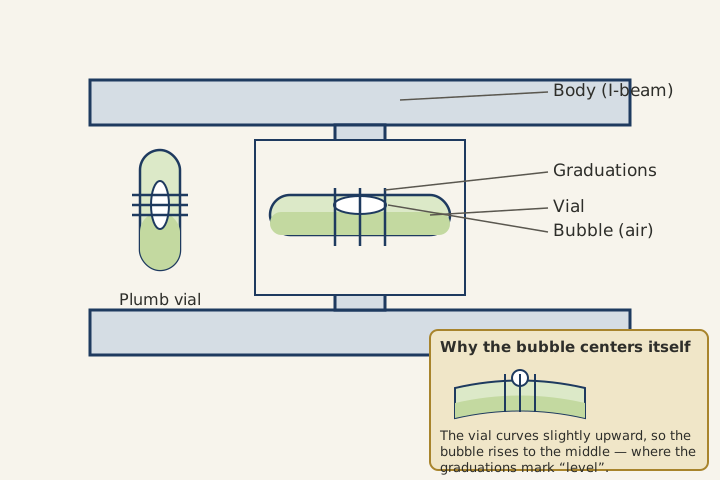
A bubble level — also called a spirit level — is a straight frame carrying one or more sealed vials, each half-filled with liquid and one air bubble. The vials are slightly curved, so the bubble always rises to the highest point, which is the center of the vial. When the bubble sits between the two graduation marks, the surface the level rests on is horizontal; a vertical vial does the same for plumb. The frame provides a straight reference edge, and the vials convert “is this flat?” into a reading your eye can judge in a second.
Why it is called a “spirit” level
The name has nothing to do with ghosts. The liquid inside the vial is a spirit — an alcohol such as ethanol. Wikipedia notes that alcohol is preferred over water because it has a wider temperature range, will not freeze, and offers less friction to the bubble, which makes the reading faster and more accurate. Johnson Level, a level manufacturer, says the fluid is typically a yellowish-green solution with additives for UV protection, rated for temperatures from about −20 °F to 130 °F (−29 °C to 54 °C). A colorant is added so the bubble is easy to see against the liquid.
The parts, in order
- Frame (body). The straight beam — wood, aluminium, or composite — that gives the tool its reference edge. Two common profiles are the box level (a hollow rectangular tube) and the I-beam level. The bottom edge is the working surface; some models have a magnetic edge that sticks to steel.
- Vials. The heart of the tool. A typical level has a long vial in the center for horizontal work and short vials near the ends for vertical (plumb) work; many torpedo levels add a third vial set at 45°. Each vial is a sealed tube with the liquid and a single air bubble.
- Bubble. The air pocket left in the sealed vial. It is the indicator.
- Graduations. The etched lines around the vial. The bubble is “level” when it is centered between them. Spacing is commonly about 2 mm.
- End caps and window. Small caps seal the vials, and the frame is machined with windows so the vials are visible without weakening the beam. A hanging hole at one end is standard.
How the vial does the trick
The clever part is the vial’s shape. A normal straight tube would let the bubble wander to whatever end is higher, which is useless. Instead, the vial is made with a very slight upward curve along its length, so the highest point is the middle. The bubble — being a pocket of air — always rises to the highest point, so it parks in the center when the vial is level, and drifts off-center the moment the surface tilts. For levels that must also work upside down, the tube is made barrel-shaped, wider in the middle, so the bubble re-centers in either orientation. A separate family, the bull’s-eye level, uses a circular vial with a convex top and a center ring to level a surface in a full plane rather than along one line.
How to read it honestly
Johnson Level’s method: rest the bottom edge on the surface, with the vial running parallel to the line you are checking, and let the bubble settle. Put your eye level with the vial and close the other eye. If the bubble is centered between the lines, the surface is level. If the bubble sits to the right of the lines, the surface slopes down from left to right (the bubble has risen toward the high end); the reverse for the left. The same procedure against a vertical surface checks plumb.
Because the tool itself can be out of calibration, the flip test matters: place the level on a flat surface, mark its position, take a reading, then rotate it 180° end-for-end onto the same marks. If the bubble gives the same reading both times, the level is accurate. If not, the vial is off — Wikipedia describes adjusting by moving the vial in its housing to take up half of the discrepancy each try. This is worth doing before any job where “level” has to be true.
Accuracy and sensitivity
Levels are rated by sensitivity — how far the bubble moves per unit of tilt. Johnson Level states that the best conventional levels are accurate to within ±0.5 mm per meter, equivalent to about 0.029 degrees (about 0.0005 inches per inch); the next common grade is 0.75 mm/m, about 0.043 degrees. On a surveyor’s level, Wikipedia notes, a 2 mm bubble movement corresponds to a tilt of about 0.005 degrees, while a precision machinist’s level moves the bubble one division for roughly “five tenths per foot” — machinist shorthand for 0.0005 inches per foot. The takeaway: an ordinary hardware-store level is plenty for hanging a picture, and a precision level is a different instrument for machine setup.
A short history
Leveling is older than the bubble. Kapro’s history notes that the Egyptians used wooden A-frames with a hanging plumb line, and the Romans used water troughs, since water naturally finds its own level. The sealed spirit vial is a 17th-century invention: the French scientist Melchisédech Thévenot built one before February 1661, a date established from his correspondence with Christiaan Huygens. Early glass vials were inconsistent, and only steady improvements in glassmaking and sealing made the tool dependable. Industrialization brought standard, mass-produced levels, and today aluminium and composite bodies, and digital and laser levels, sit alongside the classic bubble.
Common misconceptions
“The bubble floats up because air is lighter than liquid.” That is true but incomplete — the reason it lands in the center is the curved vial, not just buoyancy. “A level only needs one vial.” A tubular vial reads in only one direction; checking a surface across its width usually needs the plumb vials or a bull’s-eye. “The spirit can freeze.” Alcohol-based spirit has a much wider range than water and is chosen precisely because it does not freeze. And the base rule of every level: it is only as honest as the edge it rests on, so protect the frame from dents.
This entry is part of the measuring & marking category. For how this site verifies facts like these, see the method page, and for more tool vocabulary, try the glossary.
The construction, reading, and history claims in this entry were checked against the cited references on 18 August 2026. Corrections are welcome through the contact page.
Sources
- Wikipedia — Spirit levelaccessed 2026-08-18
- Kapro — Who Invented the Spirit Level?accessed 2026-08-18
- Johnson Level — Spirit Level Informationaccessed 2026-08-18
Spotted a mistake? Tell us about it and we will correct the entry.