What a Can Pull Tab Is Called
By Object Index Editorial TeamPublished Last reviewed
- Common name
- What a Can Pull Tab Is Called
- Category
- Kitchen & Table
- Also called
- pop tab, pop-top, ring pull, stay-on tab, ecology tab
- Typical materials
- aluminium, rivet formed in the can-end metal
- What it does
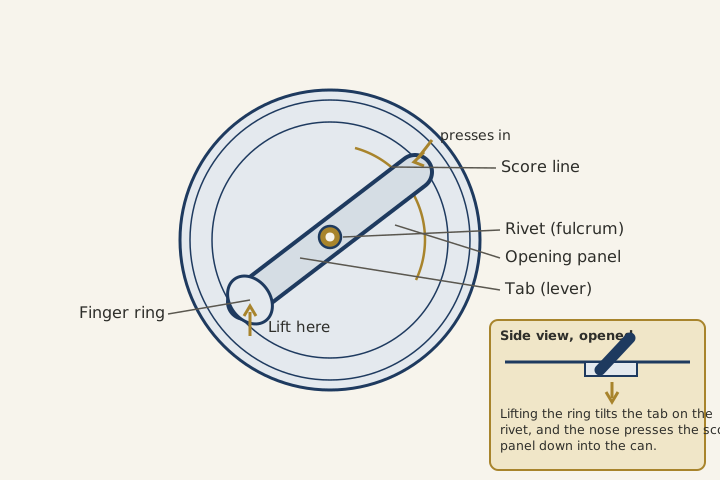
- A tab pivoting on a rivet presses a prescored panel into the can, opening a drinking hole while the tab itself stays attached to the lid.
- Last reviewed
- 2026-08-18
Direct answer
The tab on a modern drink can is called a stay-on tab, because it stays attached to the lid after opening. The whole family of these openers is known as the pop tab or pop-top; in British English it is often a ring pull. It has three working parts: the tab itself (the lever), the rivet that pins it to the lid (the fulcrum), and the score line — a shallow cut that defines the opening panel. Lifting the tab tilts it on the rivet and presses the scored panel down into the can. Earlier designs were pull-off tabs that detached entirely; those are the ones you may remember from litter.
What to call it
Vocabulary varies by era and region, and the names overlap. Smithsonian Magazine treats “pop-top” as the umbrella term for the tab openers that have topped cans for the last sixty years. The original pull-off design was marketed under several names — zip-top, snap-top, slip-top — and “ring pull” is still the common term in the UK. The modern non-detaching version is usually called a stay-on tab or ecology tab. If you call the whole thing a pop tab, everyone will understand; if you want to be precise, a modern can carries a stay-on tab, and its moving parts are the tab, the rivet, and the score.
The parts of a modern tab
Looking at a can end from above, you can identify each part. The rivet is the small round boss near the middle of the tab, formed from the metal of the lid itself, and it is the pivot point. The tab is the flat lever that reaches from the rivet out to the finger ring — the loop you hook your finger under. At the other end of the tab, toward the rim, is the nose, which sits over the score line: a thin, prescored arc in the lid. Inside that arc is the opening panel, the piece that gets pushed down. In a closed can the whole assembly is flush with the lid; the only visible hint is the score line on the rim side.
How the lever works
The opening is a classic lever. Smithsonian describes Fraze’s breakthrough as finding the answer in the rivet: when you lift the ring end, the bolted-down tab becomes a lever that breaks the prescored sipping hole near the lip of the can — near the edge where you drink — producing the familiar crack. Mechanically, lifting the ring end raises one side of the tab while the nose, on the far side of the rivet, presses down on the scored panel and snaps it inward. Because the panel is pushed into the can rather than removed, the tab stays on the lid, and there is nothing to drop or throw away. The hiss you hear is pressure releasing through the fresh opening.
Before the tab: the church key
Canned drinks were not always self-opening. Early cans required a special piercer, the “church key” — a small tool whose pointed end punched a triangular hole in the lid, usually a second hole on the far side to let air in while pouring. The gap between tool and can is what set the story in motion: at a 1959 picnic, Ermal “Ernie” Fraze of Dayton, Ohio, forgot his church key and had to open his beer with the bumper of his car. Frustrated, he set out to make a can that carried its own opener. He later told the New York Times that he did not invent the easy-open can end — “people have been working on that since 1800” — but that he developed a method of attaching a tab to the can top, which was the hard part.
The pull-off era, and why it ended
Fraze’s first design used a lever that pierced a hole, but it left sharp edges that could cut fingers; he refined it into the pull-tab we know. He received U.S. patent 3,255,917 in 1963 and sold the design to the Aluminum Company of America (Alcoa), which put it on Iron City Beer cans. By 1965 about 75% of U.S. breweries were using the tab. But the original zip-top was a pull-off tab: the ring detached completely, and millions of them ended up on streets, beaches, and in the wrong places. Smithsonian notes reports of bartenders opening cans from the bottom with a church key to avoid the sharp edge, and a 1974 New York Times report described people swallowing detached tabs and rings. The environmental and safety pressure pushed the industry to the stay-on tab: the non-removable design, made standard in the mid-1970s and characteristic of most cans since the mid-1980s, after a short-lived Coors “push-tab” experiment proved worse.
A note on the invention itself
The pop-top’s folklore sometimes credits Fraze with inventing the aluminum can; he did not. Cans for food date to the early 19th century (Peter Durand patented the first tin-coated iron cans in 1810), and the first can opener was patented by Ezra Warner in 1858. Fraze’s contribution was specifically the self-contained opening mechanism and the machinery to make it at scale — his Dayton Reliable Tool Company was supplying much of the world’s can-end machinery by 1980. The picnic story, as the Smithsonian article notes, actually undersells the engineering: scaling the idea and getting an industry to adopt it was the harder part.
Common misconceptions
“The tab comes off.” Not on modern cans — that was the old zip-top, which is exactly why it was replaced. “The score line is a manufacturing flaw.” It is the planned fracture line; without it the panel would not break cleanly. “Pop tops work by pulling the whole lid.” They work by levering one small panel inward. Next time you crack a can, you can name every part: rivet, tab, score, panel — and thank a picnic in 1959.
This entry lives in the kitchen & table category. For how facts here were verified, see the method page, or browse more object names in the glossary.
The terminology and history in this entry were checked against the cited references on 18 August 2026. Corrections are welcome through the contact page.
Sources
- Smithsonian Magazine — How Popping Open a Can Became the Sound of Summeraccessed 2026-08-18
- Wikipedia — Ermal C. Frazeaccessed 2026-08-18
- Wikipedia — Drink canaccessed 2026-08-18
Spotted a mistake? Tell us about it and we will correct the entry.