What a Grommet Is Used For
By Object Index Editorial TeamPublished Last reviewed
- Common name
- What a Grommet Is Used For
- Category
- Home & Repair
- Also called
- rubber grommet, cable grommet, insulating bushing, eyelet, blanking grommet
- Typical materials
- rubber, nylon, polychloroprene, stainless steel, plastic
- What it does
- A grommet lines the inside of a drilled or punched hole, protecting wires, cables, or ropes from the sharp edges of the hole and preventing the surrounding material from tearing.
- Last reviewed
- 2026-08-20
Direct answer
A grommet is a ring — usually rubber, nylon, or metal — that you press into a hole in a panel, wall, or piece of fabric. Its job is to line the inside of the hole with a smooth, soft surface so that whatever passes through the hole — a wire, a cable, a rope, or a pipe — does not get cut or abraded by the sharp edge of the hole itself. Without a grommet, the raw edge of a drilled hole in sheet metal acts like a knife against anything that touches it.
How a grommet works
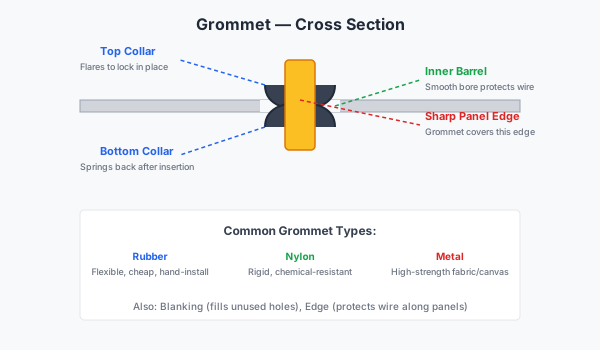
A grommet has a flared collar on both sides of a central barrel. When you press the barrel into a hole, the collar on one side compresses and passes through. Once it emerges on the other side, the collar springs back to its original shape, locking the grommet in place. The wire or cable then passes through the smooth inner bore of the barrel, protected from the sharp metal or plastic edges of the hole.
The cross-section of a grommet looks like a dumbbell: two wide discs connected by a narrow barrel. The barrel fits snugly in the hole, and the discs prevent the grommet from being pulled through.
Where grommets appear
Electrical panels and enclosures: Wires passing through holes in metal panels need grommets to prevent the insulation from being cut, which would cause a short circuit or electric shock. This is one of the most critical uses of grommets.
Furniture and desks: The round plastic insert in a desk that lets you route power cords through the tabletop is a grommet. It protects the cables from the sharp edge of the drilled hole and gives the desk a finished look.
Fabric and canvas: Grommets reinforce holes in curtains, tarps, sails, and flags. The metal ring distributes the pulling force of a hook or rope across a wider area of fabric, preventing the hole from tearing.
Automotive: Cars use grommets wherever wires pass through the firewall, door panels, or body panels. The rubber grommet seals the hole against water and vibration while protecting the wire insulation.
Maritime: Traditional rope grommets — made by unravelling and re-weaving strands of rope into a ring — were used on sailing ships as handles, oar locks, and reinforcement rings. The word “grommet” itself likely derives from the Old French “gromette,” meaning a ring or cord loop.
Types of grommets
- Rubber grommets: The most common type. Flexible, cheap, and easy to install by hand. Used in electronics, automotive, and furniture.
- Nylon grommets: More rigid than rubber, with better chemical resistance. Common in industrial applications.
- Metal grommets: Used in fabric and canvas where high strength is needed. Installed with a grommet press or a hammer and punch.
- Blanking grommets: Used to fill unused holes in panels, keeping out dust and debris. They look identical to cable grommets but serve a sealing function.
- Edge grommets: Continuous strips of rubber or plastic that snap onto the edge of a panel, protecting wires that run along a sharp metal edge rather than through a hole.
A brief history
Grommets have been used in sailing for centuries, originally as rope rings reinforcing holes in sails and canvas. The concept translated naturally to industrial use as sheet metal became a common construction material in the 19th and 20th centuries. The rubber grommet as we know it — a moulded, press-fit ring — became standard in electrical engineering during the mid-20th century as wiring density in panels and enclosures increased.
Common misconceptions
“Grommets are only for cables.” They also reinforce fabric, seal holes against water, and fill unused openings. “Any ring can serve as a grommet.” A ring that lacks the flared collar will not stay in the hole. The collar is what locks the grommet in place. “Grommets are optional.” In electrical applications, they are effectively mandatory — most wiring codes require that wires passing through sharp-edged holes be protected. “All grommets are rubber.” Metal, nylon, and plastic grommets are common, each chosen for different environmental conditions.
This entry is part of the home & repair category. For how this site verifies facts like these, see the method page, and for more hardware vocabulary, try the glossary.
The mechanical descriptions in this entry were checked against the cited references on 20 August 2026. Corrections are welcome through the contact page.
Sources
- Wikipedia — Grommetaccessed 2026-08-20
- Panduit — Rubber Grommets Catalogaccessed 2026-08-20
Spotted a mistake? Tell us about it and we will correct the entry.