What a Jar Lid's Safety Button Tells You
By Object Index Editorial TeamPublished Last reviewed
- Common name
- What a Jar Lid's Safety Button Tells You
- Category
- Kitchen & Table
- Also called
- safety button, vacuum button, pop-top lid, tamper-evident button
- Typical materials
- tinplate or aluminium lid, PVC or latex-free plastisol gasket, food-grade sealing compound
- What it does
- A concave metal button on the lid surface acts as a visual and tactile indicator of vacuum: when the jar is sealed the button is pulled down flat; when air leaks in the button pops up and can be pressed.
- Last reviewed
- 2026-08-19
Direct answer
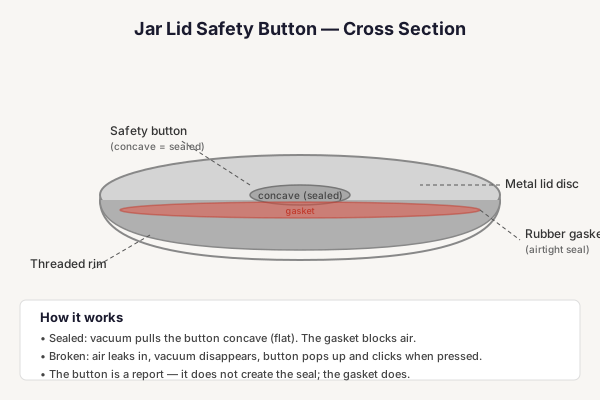
The small metal disc in the center of a jar lid is a safety button — a concave dome held in place by vacuum. When the jar is filled, sealed, and processed, hot contents drive air out and steam escapes; as the jar cools the remaining air contracts and creates a vacuum inside. That vacuum pulls the button downward so it sits flat and firm. If the seal is later compromised — by a crack in the glass, a damaged gasket, or simple age — air seeps back in, the vacuum disappears, and the button pops up. Pressing it produces a click. That click is the lid telling you the seal is broken and the contents may no longer be safe.
How the button is made
The button is not a separate part glued onto the lid. It is stamped from the same piece of metal — a concave dome pressed into the centre of the disc during manufacturing. The stamping process leaves the dome slightly convex (dome pointing up) in its relaxed state. When the jar is sealed and a vacuum forms inside, atmospheric pressure pushes the dome inward, snapping it to a concave (dome pointing down) position and locking it flat. The metal retains enough spring that the button can snap back and forth repeatedly without cracking, which is what makes the indicator reusable.
The gasket underneath
Below the lid, a ring of soft sealing compound — usually plastisol or a latex-free equivalent — sits in a channel. When the lid is screwed down onto the glass rim, the gasket compresses and forms an airtight barrier. The gasket does the actual sealing; the button simply reports whether that seal is still holding. A jar can have a perfectly flat button and still be unsafe if the gasket was never properly seated, which is why manufacturers stress following correct canning procedures.
How to read the button honestly
- Button down (flat, concave). The vacuum is intact. This is the normal sealed state for a new jar.
- Button up (raised, convex). Air has entered. The jar may have been opened, the seal may have failed, or the contents may have fermented and produced gas. Do not assume safety — even if the jar was never opened.
- Button clicks when pressed. Confirms the button is free to move, meaning there is no vacuum. A new jar should never produce this click.
The button is a one-way indicator: it tells you when vacuum is present (button down) and when it is absent (button up), but it cannot tell you why the vacuum was lost. Temperature swings, impact, or a faulty gasket can all produce the same popped button. Treat it as a warning sign, not a diagnosis.
A short history
Tedium’s history notes that the safety button was developed in the 1960s as a tamper-evident feature, partly in response to growing consumer awareness of food safety. Before the button, consumers had no visual way to tell whether a jar had been opened. The design was elegant because it required no additional parts — just a modified stamp in the lid press. By the 1980s the button was standard on commercial food jars worldwide, and today it appears on everything from baby food to pasta sauce. Mason jars use a different mechanism — a flat metal lid that flexes inward under vacuum — but the principle is the same.
Common misconceptions
“If the button is up, the food is definitely dangerous.” Not necessarily — the button can pop up from temperature changes (like leaving a jar in a hot car) without implying spoilage. But the safe default is to treat a popped button as a warning. “You can re-seal a jar by pressing the button back down.” The button will click down but will pop right back up if there is no vacuum. Pressing it does not create a seal. “The button tells you the expiration date.” The button has no connection to the printed date — it only reports vacuum status at the moment you check it.
This entry is part of the kitchen & table category. For how this site verifies facts like these, see the method page, and for more household vocabulary, try the glossary.
The mechanical and food-safety claims in this entry were checked against the cited references on 19 August 2026. Corrections are welcome through the contact page.
Sources
- Tedium — Tamper-Evident Lid Historyaccessed 2026-08-19
- Container & Packaging — Button Lids Guideaccessed 2026-08-19
- Kimecopak — Safety Button Lid Jars Guideaccessed 2026-08-19
Spotted a mistake? Tell us about it and we will correct the entry.