What the Notch in a Cable Tie Is For
By Object Index Editorial TeamPublished Last reviewed
- Common name
- What the Notch in a Cable Tie Is For
- Category
- Fasteners & Closures
- Also called
- hanging notch, mounting hook, tie hang hole, suspension tab
- Typical materials
- nylon 6/6, polypropylene, stainless steel
- What it does
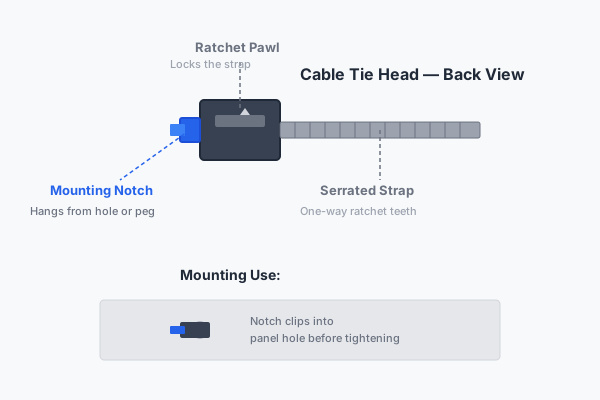
- The notch on the back of a cable tie head allows the tie to be hung from a pre-drilled hole or peg before tightening, or to interlock with another tie for extended reach.
- Last reviewed
- 2026-08-20
Direct answer
The small notch or hook on the back of a cable tie head is a mounting feature. It lets you hang the tie from a hole, peg, or edge before you thread and tighten the strap. In some designs, two notches can interlock to join two cable ties end to end, creating a longer loop than a single tie could form. The notch is not decorative and does not affect the ratcheting mechanism inside the head.
How the notch works
Most cable tie heads have two functional faces. The front face contains the ratchet pawl — the small spring-loaded tooth that clicks against the serrations on the strap and prevents the tie from loosening. The back face, opposite the pawl, carries the notch. This notch is typically a small rectangular or hook-shaped protrusion moulded into the nylon head.
When you press the notch into a matching hole in a panel or bracket, it holds the tie in position so you can route cables with one hand and tighten with the other. The notch is designed to grip the edge of the hole through friction and slight deformation of the nylon, so it stays put without additional fasteners. This is especially useful in automotive wiring, server racks, and control panels where hundreds of ties need to be positioned quickly.
Joining two ties together
Some cable tie designs feature a notch that is shaped to accept the tail of another tie. By threading the tail of a second tie through the notch on the first, you can create a chain that extends the total binding length. This is a convenience feature for wrapping large cable bundles or reaching around wide objects where a single standard-length tie would be too short. The joint is not as strong as a continuous tie, so it should not be used where the tie will bear significant load.
The ratchet and pawl — what the notch is not
It is worth distinguishing the notch from the ratchet mechanism. Inside the head, a small flexible pawl sits in a channel. As the serrated strap is pulled through, the pawl rides over each tooth and snaps back, locking the strap in place. This is what makes the cable tie a one-way fastener. The notch on the outside of the head plays no part in this locking action. It is purely a mounting and joining aid.
Material and temperature ratings
Most cable ties are moulded from nylon 6/6, a durable polymer that handles temperatures up to about 85 degrees Celsius for standard ties and up to 120 degrees Celsius for heat-stabilised variants. Below freezing, nylon becomes brittle and can crack under load, which is why outdoor installations often useUV-stabilised or stainless steel ties. The notch material is the same nylon as the head and body, so its temperature and UV limitations are identical.
Specialty cable ties made from polypropylene or Tefzel (ETFE) are used in chemical plants, marine environments, and aerospace applications where nylon would degrade. These ties still feature notches, but the notch geometry may differ because the alternative plastics have different stiffness and memory characteristics.
A brief history
Cable ties were invented by Thomas & Betts in 1958 under the brand name Ty-Rap, originally designed for aircraft wiring harnesses. The early designs used a metal tooth for the ratchet and did not include an external notch. As the product evolved and manufacturers moved to all-nylon construction, the mounting notch was added as a standard feature on many product lines. Today, most nylon cable ties include some form of notch, though its exact shape varies between manufacturers and tie sizes.
Common misconceptions
“The notch is a defect or leftover from the mould.” It is an intentional design feature present on most cable tie heads. “The notch weakens the head.” The notch adds material to the head rather than removing it, so it does not reduce the head’s structural strength. “You must use the notch every time.” The notch is optional — most cable ties work perfectly well without being hung from anything. It simply makes installation easier in certain situations. “All cable ties have the same notch shape.” Notch geometry varies between manufacturers and even between product lines from the same manufacturer. Not every notch will fit every hole.
This entry is part of the fasteners & closures category. For how this site verifies facts like these, see the method page, and for more hardware vocabulary, try the glossary.
The mechanical explanations in this entry were checked against the cited references on 20 August 2026. Corrections are welcome through the contact page.
Sources
- Wikipedia — Cable tieaccessed 2026-08-20
- Panduit — Cable Tie Reference Guideaccessed 2026-08-20
Spotted a mistake? Tell us about it and we will correct the entry.