What the Numbers on a Bottle Cap Mean
By Object Index Editorial TeamPublished Last reviewed
- Common name
- What the Numbers on a Bottle Cap Mean
- Category
- Kitchen & Table
- Also called
- lot code, batch code, production code, date code, Julian date code
- Typical materials
- tinplate, aluminium, plastic liner
- What it does
- A code printed under the bottle cap identifies the production line, batch, date, and sometimes time of manufacture, allowing the manufacturer to trace the product back to its origin if a recall is needed.
- Last reviewed
- 2026-08-20
Direct answer
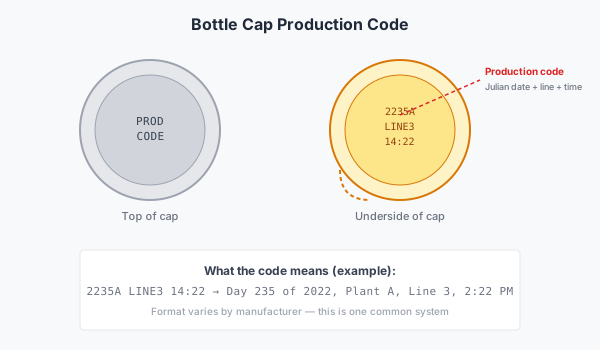
The number printed under a bottle cap — or sometimes on the bottom of the bottle — is a production code. It typically encodes the date, time, and production line where the product was filled. It is not an expiration date, a serial number, or a consumer-facing quality rating. Manufacturers use these codes internally so that if a defect or contamination is discovered, they can trace the problem back to a specific batch and recall only the affected products rather than everything they have ever made.
How the code works
There is no universal format for under-cap codes. Each manufacturer develops its own system, and the same company may use different formats across product lines. However, most codes share common elements:
- Date component: Often a Julian date (day of the year, 001 to 365/366) or a Julian date with a year digit. For example, 2235 could mean the 235th day of 2022.
- Line or plant identifier: A letter or number that indicates which factory and production line filled the bottle.
- Time or batch identifier: Additional digits that narrow the code down to a specific run within the day, sometimes to the hour.
Some manufacturers add a separate “best by” or “use by” date on the label or cap, but this is distinct from the production code. The production code is for internal traceability; the expiry date is for the consumer.
Why the code matters
Production codes are the backbone of food safety recalls. When a contamination event occurs — say, a batch of juice tests positive for a pathogen — the manufacturer uses production codes to identify exactly which bottles were filled during the affected run. They can then issue a targeted recall for only those bottles, rather than pulling every product off every shelf.
The system works because every bottle in a batch shares the same code. If a consumer reports a problem, the company can look up the code, find the production records, and determine whether that bottle was part of an affected lot. In some cases, consumers can report the code to the manufacturer through a customer service line or website, which helps the company track quality issues in real time. Having the code ready when filing a complaint can speed up the investigation and response.
Where the code appears
The code is usually printed with ink-jet dot-matrix printing directly on the inside of the cap, on the underside of the cap liner, or on the bottom of the bottle. It is intentionally small and hard to read because it is not meant for consumers — it is meant for the manufacturer’s internal tracking systems and for regulators during inspections.
Some products also carry a separate, more legible “best before” or “use by” date on the cap, label, or neck band. This consumer-facing date is the one that actually matters for shelf-life decisions, and it is printed in a larger, easier-to-read font.
A brief history
Standardised production coding became widespread in the food and beverage industry during the mid-20th century as manufacturing scaled up and regulatory agencies began requiring traceability. The system was formalised by industry bodies like GS1, which provides global standards for batch and lot numbering. Before production codes, recalls were imprecise — manufacturers had to pull entire product lines because they could not identify which specific batches were affected.
Common misconceptions
“The number under the cap is an expiry date.” It usually is not. It is a production code. The expiry date is typically printed separately on the label, cap, or neck band. “Every brand uses the same code format.” They do not. There is no industry-wide standard for consumer-visible codes. “If the code is hard to read, the product is counterfeit.” The codes are intentionally small and printed with ink-jet dots, which can look irregular. This is normal. “You can decode the number yourself.” Sometimes, if you know the brand’s system, you can approximate the production date. But the full meaning of the code — including the specific factory and line — is proprietary information.
This entry is part of the kitchen & table category. For how this site verifies facts like these, see the method page, and for more household vocabulary, try the glossary.
The production coding practices described in this entry were checked against the cited references on 20 August 2026. Corrections are welcome through the contact page.
Sources
- GS1 — Batch and Lot Numberingaccessed 2026-08-20
- FDA — Product Dating and Labelingaccessed 2026-08-20
Spotted a mistake? Tell us about it and we will correct the entry.