Why a Ruler Starts Before Zero
By Object Index Editorial TeamPublished Last reviewed
- Common name
- Why a Ruler Starts Before Zero
- Category
- Measuring & Marking
- Also called
- zero offset, ruler margin, end allowance, zero gap
- Typical materials
- stainless steel, hardwood, fibreglass-reinforced plastic
- What it does
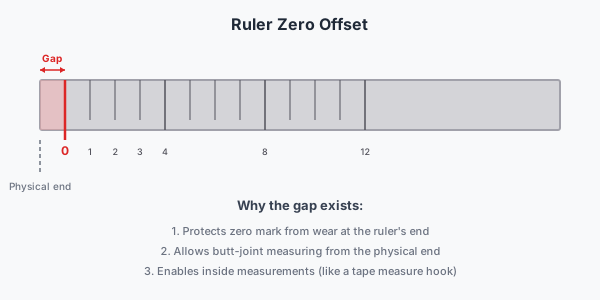
- The gap between the physical end of a ruler and the zero graduation protects the scale from wear caused by repeated contact with edges, and allows the ruler to be hooked over a surface for accurate inside measurements.
- Last reviewed
- 2026-08-20
Direct answer
The gap between the physical end of a ruler and the zero graduation exists for two practical reasons. First, the end of any ruler is the part most likely to be nicked, dented, or worn down from being dropped, scraped against surfaces, or stored point-first in a toolbox. By placing the zero mark a few millimetres inward, the ruler remains accurate even if the physical end suffers minor damage. Second, the gap allows the ruler to function as an inside-measuring tool: you can hook the zero end over the edge of a surface and measure from the outside, just as a tape measure hook slides for the same purpose.
How the gap works
Take any steel ruler and look closely at the first centimetre. You will see a small space — typically 1 to 3 millimetres — between the physical end of the ruler and the first graduation line. That space is the zero offset. It means the zero mark does not sit at the very edge of the material.
When you butt the end of a ruler against a wall and read the measurement at the other end, you are measuring from the physical end of the ruler, not from the zero mark. The zero mark is irrelevant in this orientation. But when you align the zero mark with the edge of a workpiece — the standard way to take a measurement — the gap ensures that the zero line is fresh and undamaged, giving you a clean, accurate reference point.
Inside vs. outside measurements
A ruler with a zero offset can also take inside measurements. If you need to measure the inside width of a box, you can press the physical end of the ruler against one interior wall and read the measurement where the other wall meets the scale. The zero offset is now irrelevant because you are reading from the end of the ruler, not from the zero mark.
This is the same principle that makes a tape measure hook slide: both designs account for the fact that the measuring reference point changes depending on whether you are measuring from an edge or into a space.
Why steel rulers are preferred
Professional machinists and woodworkers favour stainless steel rulers because the metal resists wear far better than plastic or wood. A steel ruler’s zero offset will remain accurate for years of daily use, while a plastic ruler’s end may deform or chip, shifting the effective zero. Starrett, a leading manufacturer of precision tools, recommends steel rules for any measurement where accuracy within a fraction of a millimetre matters.
Metric vs. imperial rulers
Most rulers carry either metric (millimetre) graduations or imperial (fractional inch) graduations, and some carry both. The zero offset works the same way regardless of the unit system. However, the offset distance itself may differ between metric and imperial rulers because the graduation spacing is different. On a metric ruler, the offset is typically 1 to 3 millimetres. On an imperial ruler, it may be as much as 3/32 of an inch (about 2.4 millimetres) because the fractional divisions start at 1/64 of an inch and need slightly more clearance.
Combination rulers — those with metric on one edge and imperial on the other — are popular in workshop settings where plans may reference either system. The zero offsets on each edge are independent and may not be the same distance from the physical end.
A brief history
Rulers in various forms have existed since ancient Egypt and Mesopotamia, where stone and metal bars served as length standards. The modern graduated ruler with a zero offset became standard during the industrial revolution, when interchangeable parts demanded consistent, repeatable measurements. The zero offset was an early engineering solution to the problem of wear at the reference end — a problem that remains relevant today.
Common misconceptions
“The gap is wasted space.” It is protective space. The cost of losing a few millimetres at the end is far less than the cost of inaccurate measurements from a worn zero line. “You should always read from the zero mark.” Not necessarily. When measuring from a butt-joint or inside corner, you read from the physical end of the ruler. “All rulers have the same zero offset.” They do not. Offset distances vary between manufacturers and between metric and imperial rulers. Some precision rulers have no offset at all, relying on hardened tips to resist wear.
This entry is part of the measuring & marking category. For how this site verifies facts like these, see the method page, and for more measurement vocabulary, try the glossary.
The mechanical explanations in this entry were checked against the cited references on 20 August 2026. Corrections are welcome through the contact page.
Sources
- Wikipedia — Ruler (measuring instrument)accessed 2026-08-20
- Starrett — Precision Measurement Toolsaccessed 2026-08-20
Spotted a mistake? Tell us about it and we will correct the entry.