Why a Tape Measure Hook Slides
By Object Index Editorial TeamPublished Last reviewed
- Common name
- Why a Tape Measure Hook Slides
- Category
- Measuring & Marking
- Also called
- end hook, tang, hook rule end, loose hook
- Typical materials
- hardened steel tang, steel or aluminium rivets, nylon-coated steel blade
- What it does
- The sliding hook compensates for its own thickness: when hooked over an edge it pulls out to start the scale at the outer face; when pressed flat against a surface it pushes in to start at the inner face.
- Last reviewed
- 2026-08-19
Direct answer
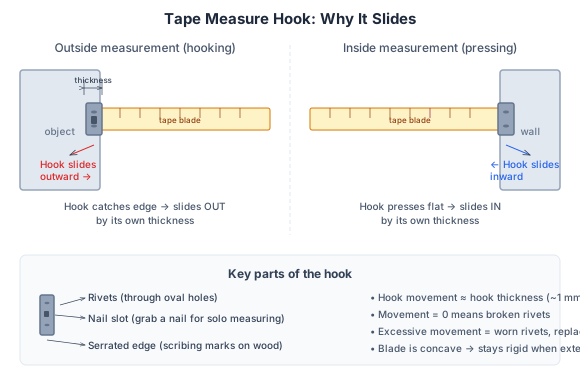
The metal hook at the end of a tape measure is deliberately loose. It slides back and forth a short distance — exactly the thickness of the hook itself — so that whether you hook it over an edge or press it flat against a surface, the zero mark lines up with the correct starting point. When you hook the hook over the end of a board, the vacuum pulls it outward and the scale begins at the board’s outer face. When you press the hook flat against a wall for an inside measurement, it pushes inward and the scale begins at the wall’s inner face. Without this sliding movement, every measurement would be off by the thickness of the hook — roughly 1.5 mm.
How it works
The hook is attached to the blade by two or three rivets passing through oval-shaped holes in the tang. The rivets are intentionally left slightly loose, so the tang can slide along the length of those ovals. The distance the hook can move is precisely controlled: Family Handyman and the Seattle Times both explain that the travel equals the thickness of the metal hook. This means the zero graduation on the blade always starts at the correct reference point, regardless of which measurement technique you use.
Outside measurement (hooking)
When you hook the tang over the edge of a workpiece and pull, the rivets slide to the far end of their slots. The hook extends outward by its own thickness, and the zero mark on the blade aligns with the outer face of the material. The result is an accurate measurement from the very edge.
Inside measurement (pressing)
When you press the flat face of the hook against a wall or the inside of a cabinet and push the blade forward, the rivets slide the other way. The hook pushes inward, and the zero mark now starts at the inner surface. Without this compensation, you would need to subtract the hook thickness from every inside measurement manually.
The notch on the hook
Most tape measure hooks also have a small notch or slot cut into the end. This lets you catch the hook on a nail head or screw when measuring alone — press the notch against the fastener and pull, and the hook stays put while you extend the blade. This is a convenience feature, not related to the sliding mechanism.
When the hook is truly broken
A hook that slides freely without any resistance, or that falls off entirely, has failed — the rivets have worn through or the tang has cracked. But a hook that wiggles slightly and returns to a neutral position is behaving exactly as designed. The distinction is simple: controlled sliding is normal; uncontrolled flopping means the tool needs attention.
Signs of a worn hook include: the tang no longer returns to a consistent neutral position; the rivets are visibly loose or corroded; or the hook can be pulled off the blade by hand. Because the hook is a safety-critical part of the measuring system, most manufacturers sell replacement end hooks as spare parts. Fitting one requires riveting — a task for a bench vice and a hammer, not a screwdriver.
Why every brand does it
The sliding-hook design is not a patent or a trade secret — it is a straightforward mechanical solution that every tape-measure manufacturer has adopted. The Family Handyman notes that whether you buy a budget tape from a discount bin or a professional-grade model, the hook will slide. The reason is simple: there is no cheaper way to compensate for the hook’s thickness without making the tool significantly more complex or expensive. The oval-slot-and-rivet system costs almost nothing to produce, adds no moving parts beyond the hook itself, and delivers the same accuracy improvement on every unit.
A brief history
The steel tape measure as we know it dates to the mid-19th century, when European workshop rulers were made from thin, flexible steel. The sliding hook appeared early in the tool’s evolution because the error it corrects — the thickness of the end piece — was obvious to anyone who tried to measure from a flat surface versus hooking over an edge. By the early 20th century the design was standard on professional tapes, and today it is so universal that most users never notice the rivets or wonder why the hook moves.
Common misconceptions
“My tape measure is defective.” The sliding hook is a universal feature across every major brand. “I should glue the hook in place.” This defeats the purpose and guarantees inaccurate measurements. “The loose rivets mean poor quality.” The opposite — precision-stamped oval holes and controlled rivet clearance are deliberate engineering. “The slide is only a few thousandths of an inch — it doesn’t matter.” On a 1.5 mm hook, that difference is noticeable. On longer measurements it compounds with other errors, and good practice is to account for it.
This entry is part of the measuring & marking category. For how this site verifies facts like these, see the method page, and for more tool vocabulary, try the glossary.
The mechanical explanations in this entry were checked against the cited references on 19 August 2026. Corrections are welcome through the contact page.
Sources
- Family Handyman — Why the End of Your Tape Measure Is Looseaccessed 2026-08-19
- The Seattle Times — Loose tape-measure rivets improve accuracyaccessed 2026-08-19
Spotted a mistake? Tell us about it and we will correct the entry.