Why a Combination Wrench Has Two Different Ends
By Object Index Editorial TeamPublished Last reviewed
- Common name
- Why a Combination Wrench Has Two Different Ends
- Category
- Fasteners & Closures
- Also called
- combination spanner, open-ring spanner, combo wrench
- Typical materials
- chromium-vanadium alloy steel, chrome-plated drop-forged steel
- What it does
- A combination wrench gives you two ways to grip the same bolt: the open-end jaw slips on from the side for quick work, while the box-end ring encloses the fastener for higher torque and less rounding.
- Last reviewed
- 2026-08-21
Direct answer
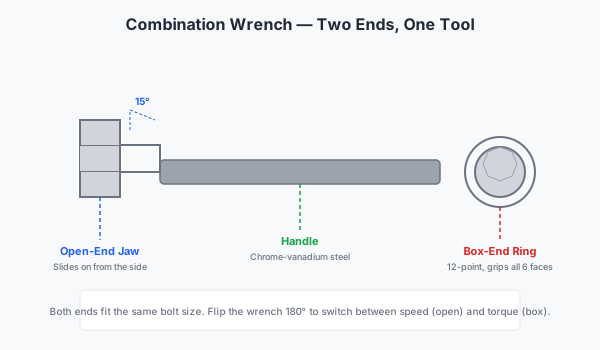
A combination wrench carries two different ends because each end solves a different problem. The open-end jaw — the U-shaped slot — lets you slide the wrench onto a bolt from the side, which is fast and convenient when you have clear access. The box-end ring — the closed loop — wraps completely around the fastener, gripping all six faces of a hex nut at once so you can apply more torque without the wrench slipping off. Both ends are typically sized for the same bolt, but they are shaped differently because speed and grip strength pull the design in opposite directions.
The 15-degree offset
Both ends of a standard combination wrench are angled at approximately 15 degrees to the axis of the handle. This is not decorative — it is a direct response to the geometry of tight spaces. When you turn a wrench in a confined area, the handle can only swing through a limited arc before it hits something. By angling the jaw 15 degrees, the designer gives you an extra range of motion: you can flip the wrench over and re-engage the fastener at a different angle without removing it entirely. In practice, this means you can tighten or loosen a bolt in a space where a straight wrench would need to be fully removed and repositioned after every partial turn.
The 15-degree angle also shifts the handle slightly away from the plane of the fastener, which keeps your knuckles clear of nearby surfaces. On a box-end wrench the offset is even more pronounced — the ring sits above the handle on a short neck — because the closed ring needs clearance to rotate around the bolt head.
The open end
The open-end jaw is essentially a U-shaped slot with parallel jaws that grip two opposite flat faces of a hex bolt. It is fast to position: you slide it onto the fastener from any direction without needing to lower it over the top. The trade-off is that the jaw only contacts two faces, so it relies on friction and the user’s grip to stay seated. Under high torque, an open-end wrench can slip and round off the corners of a bolt head, especially if the jaw has worn over time.
Open-end jaws are angled at 15 degrees to the handle axis. This angle is the reason a single wrench can work in spaces where the handle can only travel a few degrees at a time — flip the wrench and you engage the next tooth of the hex at a new angle.
The box end
The box end is a closed ring, usually with a 12-point interior profile. It slides over the top of a bolt or nut and encloses it completely, contacting all six flat faces simultaneously. This distributed grip means the wrench can apply significantly more torque without slipping or deforming the fastener. The 12-point profile is not arbitrary — it allows the ring to fit onto a hex fastener at twice as many angles as a 6-point ring (every 30 degrees instead of every 60), which matters in tight spaces where you can only swing the handle a small amount.
The downside of the box end is that you must lower it over the top of the fastener. You cannot slide it on from the side, so it requires vertical clearance above the bolt. In deep engine bays or behind panels, this clearance may not exist — which is exactly when you reach for the open end instead.
Why one wrench, two ends
Before combination wrenches became standard, mechanics carried separate open-end and box-end wrenches for every bolt size. A typical automotive job might require ten or fifteen individual wrenches. The combination wrench collapsed this into one tool per size: the open end for quick positioning and the box end for final tightening. The result is fewer tools in the toolbox and less time spent swapping between them.
The design became possible in the early 20th century as drop-forging techniques improved. Forging a single piece of chromium-vanadium steel with two different end profiles was cheaper and stronger than brazing or riveting two separate heads onto a handle. By the mid-20th century the combination wrench was the default hand wrench in most toolkits worldwide.
A brief history
Wrenches have existed in some form since at least the 15th century, when blacksmiths used them to tighten clamps on suits of armour. The open-end wrench as we know it — a one-piece tool with a U-shaped jaw — was refined in the late 18th and early 19th centuries, initially as an adjustable coach wrench for the odd-sized nuts on wagon wheels. The box-end wrench followed later, once precision stamping and forging made it possible to produce closed rings with consistent internal dimensions.
The combination of both ends on a single handle emerged in the early 20th century as the automotive industry created demand for compact, versatile hand tools. The name “combination” simply describes the union of two previously separate tool types. Today, most combination wrenches are manufactured from drop-forged chromium-vanadium alloy steel and chrome-plated for corrosion resistance — a material choice that balances strength, weight, and durability.
Common misconceptions
“The two ends must be different sizes.” On a combination wrench they are almost always the same size — both ends fit the same bolt. Double-open-end wrenches (with two different-sized U-jaws) are a separate category. “The 15-degree angle is just for looks.” It is a functional design that increases the usable swing arc in confined spaces. “Box-end wrenches always have 12 points.” Six-point box ends exist and provide better grip on soft fasteners, but 12-point is more common because of its versatility. “You should always use the box end.” The open end is faster when you have clearance and need to reposition often — the two ends complement each other.
This entry is part of the fasteners & closures category. For how this site verifies facts like these, see the method page, and for more hardware vocabulary, try the glossary.
The mechanical explanations in this entry were checked against the cited references on 21 August 2026. Corrections are welcome through the contact page.
Sources
- Wikipedia — Wrenchaccessed 2026-08-21
- Wikipedia — Ratchet (device)accessed 2026-08-21
Spotted a mistake? Tell us about it and we will correct the entry.