Why Door Hinges Have Removable Pins
By Object Index Editorial TeamPublished Last reviewed
- Common name
- Why Door Hinges Have Removable Pins
- Category
- Home & Repair
- Also called
- loose-pin hinge, butt hinge, mortise hinge
- Typical materials
- steel, brass, or stainless steel, zinc-plated or solid brass pin
- What it does
- Two leaves are joined by interlocking knuckles and a vertical pin; pulling the pin separates the leaves so the door can be lifted off the frame.
- Last reviewed
- 2026-08-18
Direct answer
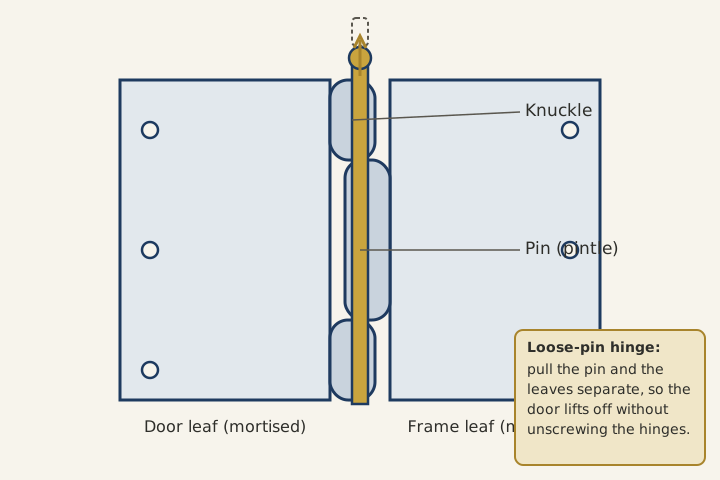
The removable pin is what makes a loose-pin hinge a loose-pin hinge. On a standard interior door, the hinge is a butt hinge: two flat leaves joined by a row of hollow knuckles, with a vertical pin running through them. Because that pin is removable, you can pull it out — usually with a nail set and hammer from the top — and the two leaves separate. The door then lifts off the frame without you turning a single screw. That is the whole point of the design: quick removal for painting, repairs, or swapping doors.
What a butt hinge is
The most common door hinge in homes is the butt hinge, and it is also called a mortise hinge because it is set into a recess cut in the wood. HingeOutlet’s summary is clean: a butt hinge has two rectangular leaves with screw holes, and the leaves are connected by a pin or metal rod; the leaves are mortised, one into the edge of the door and the other into the jamb. When the door closes, the leaves meet — they “butt” together — with only the pin showing. Wikipedia adds that any hinge designed to be set into a door or frame counts as a butt or mortise hinge, and most of them are also barrel hinges because of the way they pivot.
The parts
Three parts do all the work:
- Leaf. One of the two flat plates with screw holes. One leaf is screwed to the door, the other to the frame.
- Knuckle. The hollow, roughly circular cylinder at the hinge edge of each leaf. The knuckles of the two leaves alternate and interlock — door leaf, frame leaf, door leaf — forming a continuous tube.
- Pin (also called a pintle). The rod that passes through all the knuckles, holding the leaves together while still letting them rotate. The pin is the hinge’s axis.
Wikipedia’s terminology section describes exactly this: the pin is the rod inside the knuckle, the knuckles are the hollow portions that interlock, and the leaves are the portions that extend laterally. “End play” — the small axial gap between knuckles — is what lets the leaves rotate without binding.
Why the pin is removable
The benefit is maintenance. With a loose-pin hinge, you pull the pin, and the door detaches from the frame with the hinges still screwed in place — Millard Lumber’s installation guide calls this the primary advantage of the loose-pin hinge: you can remove the door for any purpose without unscrewing the hinges. That is why painters, carpenters, and anyone changing door hardware love them. The practical details matter: the pin should be removed from the top, and hinge “handing” (right-hand vs. left-hand) is usually reversible by flipping the hinge and reinserting the pin from the other end. To remove a stubborn pin, use a nail set or a drift punch — not a screwdriver — to avoid mushrooming the pin head.
The security catch
A removable pin is also a security weakness if an intruder can reach the hinge edge of an exterior door. Hardware suppliers address this with security hinges: either fixed-pin hinges whose pins cannot be removed, or loose-pin hinges fitted with a small set screw or security stud that locks the pin in place. IQS Directory’s overview of butt hinges notes the same trade-off — fixed pins for added security versus removable pins for easier door removal — as a key consideration in safety-critical applications. The rule of thumb is simple: removable pins are fine on interior doors; use security-pin or non-removable-pin hinges on exterior doors, especially those with outward swing.
Variants that build on the idea
The “lift the pin, lift the door” idea shows up in other forms. A flag hinge is a two-part hinge where a leaf carrying the pin inserts into a leaf with a matching hole, so the hinged object can be lifted straight off — common on removable gates and panels. Ball-bearing hinges keep the same butt-hinge shape but put ball bearings between the knuckles so heavy doors swing smoothly without sag. Continuous (piano) hinges run the full length of the door and are screwed in place, with a pin that can be driven out to separate the leaves entirely. All of them are barrel hinges underneath — the pin-and-knuckle idea is the most widespread hinge mechanism there is.
A short history
Hinges predate doors with screws. Ancient Egyptian doors used pivot hinges — dowels protruding from the door edge turning in stone sockets — and the Romans called a hinge cardō, a word that survives in “cardinal” as “the chief thing something turns on.” The English word “hinge” is related to “hang.” The modern butt hinge is simply the same rotation idea, industrialized: flat leaves mortised into wood, interlocking knuckles, and a pin you can take out when you need the door off.
Common misconceptions
“You have to unscrew the hinges to take a door off.” That is precisely what the removable pin avoids — this is the entire reason loose-pin hinges exist. “Removable pins make a hinge weak.” A standard loose-pin butt hinge carries interior doors without complaint; the pin is not the weak link, and security concerns are solved with security-pin hinges rather than by giving up the feature. “All door hinges have removable pins.” Many exterior and commercial hinges do not, and some pins are crimped or staked so they cannot be removed. If a pin won’t budge, check whether the hinge is meant to have a removable pin at all before you force it.
This entry is part of the home & repair category. See how this site checks claims like these on the method page, or find more hardware vocabulary in the glossary.
The terminology and behavior described in this entry were checked against the cited hardware references on 18 August 2026. Corrections are welcome through the contact page.
Sources
- Wikipedia — Hingeaccessed 2026-08-18
- Millard Lumber — Installing Hingesaccessed 2026-08-18
- HingeOutlet — The Most Common Door Hinge: The Butt Hingeaccessed 2026-08-18
- IQS Directory — Types, Uses, Features and Benefits of Butt Hingesaccessed 2026-08-18
Spotted a mistake? Tell us about it and we will correct the entry.