Why Extension Cords Have Different Plug Shapes
By Object Index Editorial TeamPublished Last reviewed
- Common name
- Why Extension Cords Have Different Plug Shapes
- Category
- Home & Repair
- Also called
- NEMA plug, rated plug, current-rated connector
- Typical materials
- PVC jacket, copper conductors, thermoplastic plug body, brass blades
- What it does
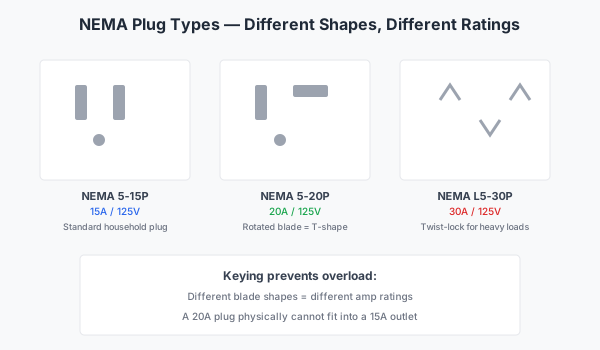
- Different plug shapes are a safety system: each NEMA configuration is keyed to a specific voltage and amperage rating, so a plug designed for a 20-amp circuit physically cannot fit into a 15-amp outlet.
- Last reviewed
- 2026-08-20
Direct answer
Extension cord plugs have different shapes because they are engineered for different current (amp) ratings, and the different shapes prevent you from plugging a high-draw appliance into a circuit that cannot handle it. In North America, the NEMA (National Electrical Manufacturers Association) standard defines specific blade configurations for each voltage and amperage combination. A 15-amp plug has two flat blades and a grounding pin. A 20-amp plug adds a horizontal slot. A 30-amp plug uses a completely different twist-lock design. The shapes are deliberately incompatible so that a 20-amp device cannot accidentally be connected to a 15-amp circuit.
How the shape prevents overload
Electrical safety depends on matching the appliance’s current draw to the circuit’s capacity. A 15-amp household circuit uses 14-gauge wire and a 15-amp breaker. A 20-amp circuit uses 12-gauge wire and a 20-amp breaker. If you could plug a 20-amp appliance into a 15-amp outlet, the wire might overheat before the breaker trips, creating a fire hazard.
The NEMA plug shape system solves this by making high-amperage plugs physically incompatible with lower-amperage outlets. The extra horizontal blade on a 20-amp plug simply does not fit into a standard 15-amp receptacle. This is called “keying” — the plug is keyed to match only outlets of its own rating.
Common NEMA plug types
- NEMA 5-15P: The standard household plug. Two flat parallel blades and a round grounding pin. Rated for 15 amps at 125 volts. This is what most extension cords use.
- NEMA 5-20P: Similar to the 5-15P but with one blade rotated 90 degrees to form a T-shape. Rated for 20 amps at 125 volts. Common on heavy-duty extension cords and large appliances.
- NEMA L5-30P: A twist-lock plug with three curved blades. Rated for 30 amps at 125 volts. Used for RV hookups, generators, and industrial equipment.
- NEMA L6-30P: A twist-lock plug rated for 30 amps at 250 volts. Used for heavy machinery and commercial applications.
Why twist-lock plugs exist
For high-current applications, a simple push-in connection is not secure enough. A 30-amp current flowing through a loose plug creates heat, which can melt the plug body and start a fire. Twist-lock plugs solve this by requiring you to insert the plug and then rotate it, which locks the blades into spring-loaded contacts inside the receptacle. The plug cannot be pulled out without twisting it back, ensuring a secure connection under heavy load.
Extension cord ratings
An extension cord’s rating is determined by two factors: the gauge (thickness) of the wire and the rating of the plug and receptacle. A 16-gauge cord with a 15-amp plug can safely carry up to 13 amps over short distances. A 12-gauge cord with a 20-amp plug can carry up to 20 amps. Using a light-duty cord for a heavy-duty appliance causes the wire to overheat, which is the leading cause of extension-cord fires.
Voltage drop over distance
Length also matters. The longer the cord, the more electrical resistance the current must overcome, and the more voltage is lost along the way. A 50-foot extension cord at full rated load can lose 3 to 5 percent of its voltage, which means the appliance receives less power than it was designed for. Motors — such as those in air conditioners or compressors — are particularly sensitive to voltage drop and may overheat or fail prematurely when undersupplied. This is why heavy-duty cords use thicker (lower-gauge) wire: the extra copper reduces resistance and keeps voltage drop within acceptable limits even at longer lengths.
Common misconceptions
“You can force a larger plug into a smaller outlet.” You should never do this. The shape incompatibility is a deliberate safety feature. “All extension cords are the same.” They are not. Wire gauge, insulation rating, plug type, and length all affect how much current the cord can safely carry. “A 20-amp plug means the cord is better quality.” It means the cord is rated for higher current. For light-duty tasks, a 15-amp cord is perfectly adequate. “Twist-lock plugs are only for industrial use.” They are also standard on RV power connections, portable generators, and camping power setups.
This entry is part of the home & repair category. For how this site verifies facts like these, see the method page, and for more electrical vocabulary, try the glossary.
The electrical standards described in this entry were checked against the cited references on 20 August 2026. Corrections are welcome through the contact page.
Sources
- Wikipedia — NEMA connectoraccessed 2026-08-20
- US Forest Service — Extension Cord Safetyaccessed 2026-08-20
Spotted a mistake? Tell us about it and we will correct the entry.