Why Some Screws Have an Unthreaded Shank
By Object Index Editorial TeamPublished Last reviewed
- Common name
- Why Some Screws Have an Unthreaded Shank
- Category
- Fasteners & Closures
- Also called
- plain shank, shoulder, grip length
- Typical materials
- carbon steel, stainless steel, brass
- What it does
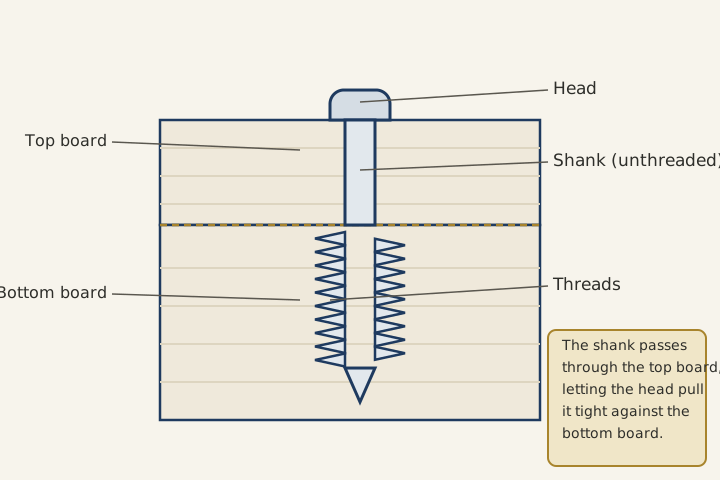
- The unthreaded shank below the head lets the head pull the upper part of a joint tight against the lower part, while the threads do the gripping below.
- Last reviewed
- 2026-08-18
Direct answer
A screw with a smooth, unthreaded section under the head is not missing threads. That plain section — the shank — lets the screw do something a fully threaded screw cannot: pull the two parts of a joint firmly together. The shank passes through the upper piece, so the head drags that piece down tight against the lower one while the threads grip below. Once installed, the shank also resists bending and shear, and while the screw is being driven it carries away friction heat. Not every screw has one — it is a deliberate design choice, and this article explains why it exists.
The three parts of a screw
Fastener suppliers describe a screw as having three working zones. The head carries the drive (slot, Phillips, hex, Torx) and is the part you turn. The shank is the smooth portion immediately beneath the head, with no threads. The threaded portion runs from below the shank down to the tip. A screw that keeps a smooth section is called partially threaded; one threaded from head to tip is fully threaded. Because the terms are used loosely across brands, it helps to check the drawing or the package: the same nominal size can come in either form.
What the shank actually does: clamping
The main job of the unthreaded shank is to turn a screw into a clamp. Albany County Fasteners puts it directly: a fully threaded screw driven into wood will connect two pieces, but it will not pull them against each other. Once the head touches the material, a fully threaded screw stops pulling — the threads are already gripping the upper piece, so nothing is drawn tight. With a shank, the tip pulls the screw into the lower material while the smooth shoulder slides through the first board; the head then presses that first board down against the second, creating compression between the head and the threads. That compression — clamping force — is the whole point of the design.
This is why wood screws and deck screws are usually partially threaded: the joint gets pulled together as you drive, and the same geometry makes the screw easier to remove later, because the threads are only engaged where they are needed. The obvious warning is over-tightening — once the two boards are snug, more torque only buries the head deeper into the wood.
The second job: staying cool
There is a less visible reason for the shank, and it matters for hardwoods and long screws. Driving a fully threaded screw generates friction along its whole length, and friction generates heat. Heat makes the metal expand; an expanded screw can seize inside the hole it was meant to fit; and overheated steel loses strength and snaps. The shank interrupts that: the threads still generate heat, but the smooth shank passes through the upper material with almost no friction, and it gives the heat a place to dissipate. This is exactly the difference between a wood screw and a sheet-metal screw — use a fully threaded sheet-metal screw in wood and you may watch it heat up, bend, and break, which is a common beginner failure.
In metal: bolts, grip length, and shear
The same geometry appears on bolts, where the plain section is called the grip length. A bolt is driven through pre-drilled holes and paired with a nut, and its shank is the part that sits between the two clamped parts. FMW Fasteners notes that the unthreaded segment contains none of the stress-raising notches of a thread, so the grip length has no weak points to strain. That matters because the threaded part is cut down to a smaller root diameter: the full-diameter shank is the strongest section of the fastener, and it is also the section that best resists the bending and shear forces acting on an installed fastener. This is why shear-loaded joints — where the parts try to slide sideways across the bolt — are usually assembled with the shank spanning the joint, not the threads.
Why not every screw has one
The shank is a trade, not a free bonus. In exchange for clamping power you give up thread engagement in the upper piece. That is fine when the upper piece is thin and you want it drawn down, but it is wrong when you need maximum grip inside a single thick board or when both pieces are soft and need threads. Fully threaded screws are standard for sheet metal and for applications where the two parts are already fixed and only need to be held. The practical lesson from fastener suppliers is to match the type to the job: for clamping two boards, reach for the partially threaded screw; for gripping within one material, use the fully threaded one. And for the shank to do its work, the upper piece needs a hole that clears it — bolts get pre-drilled holes by design, and wood-screw jobs usually start with a pilot hole.
Terminology worth knowing
- Shank (also called the shoulder): the smooth section under the head.
- Grip length: the unthreaded span of a bolt that sits between the clamped parts.
- Partially threaded (PT): a screw or bolt with a shank.
- Fully threaded: threads run from under the head to the tip.
Common misconceptions
“The threads were stripped off.” No — the shank is manufactured smooth on purpose; a stripped screw looks irregular, while a shank has a clean, consistent finish. “Fully threaded is always stronger.” It has more grip, but the shank is the strongest section against bending and shear. “It’s just for looks.” The clamping, cooling, and shear roles above are all functional. If you remember one sentence: the shank exists so the head can pull, and the threads can hold.
Need the names for the rest of a screw, or related fastening vocabulary? Browse the fasteners & closures category or the glossary. You can also read how this site picks and checks its sources on the method page.
The mechanical explanations in this entry were checked against the cited fastener-industry references on 18 August 2026. Corrections are welcome through the contact page.
Sources
- Albany County Fasteners — Why Do Wood Screws Have a Shank?accessed 2026-08-18
- FMW Fasteners — Full Thread vs. Partial Thread Screwsaccessed 2026-08-18
Spotted a mistake? Tell us about it and we will correct the entry.