Why Some Spoons Have a Slot
By Object Index Editorial TeamPublished Last reviewed
- Common name
- Why Some Spoons Have a Slot
- Category
- Kitchen & Table
- Also called
- draining spoon, lift-out spoon, perforated spoon
- Typical materials
- stainless steel, nylon, silicone-coated steel
- What it does
- Slots or perforations in the bowl of the spoon allow cooking liquid to drain away while the solid food remains on the spoon, combining the functions of a ladle and a strainer in one tool.
- Last reviewed
- 2026-08-20
Direct answer
A slotted spoon has slots — or sometimes round holes — cut into its bowl so that liquid drains through while solid food stays on top. It is the simplest possible combination of a spoon and a strainer. You scoop boiled vegetables, fried food, or poached eggs out of hot liquid, pause for a moment to let the liquid drain through the slots, and transfer the food to a plate without carrying a puddle of water or oil with it.
How the slots work
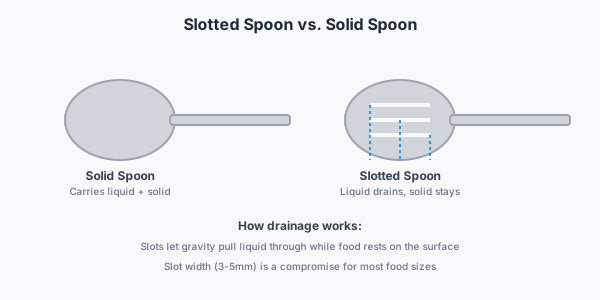
The principle is straightforward. The slots are openings in the bowl of the spoon that are wide enough for liquid to pass through but narrow enough to retain the solid food. When you lift the spoon out of the pot, gravity pulls the liquid down through the slots while the food sits on the remaining metal surface.
The shape and orientation of the slots matter. Longitudinal slots — running lengthwise along the bowl — are the most common because they maximise the draining surface area while keeping the structural integrity of the spoon. Round perforated holes distribute the draining force more evenly but are weaker under heavy loads. Some spoons combine both patterns.
Slot size and food type
The ideal slot width depends on what you are cooking. For poached eggs, the slots need to be narrow enough that the white does not sag through. For boiled potatoes, the slots can be much wider. Most slotted spoons use a compromise width of about 3 to 5 millimetres, which works adequately for most foods but is not optimal for any single one.
Specialist slotted spoons exist for specific tasks. A spider skimmer — common in Chinese cooking — uses a wide wire mesh instead of slots, allowing extremely fast drainage for deep-fried foods. A perforated Turkish serving spoon has tiny round holes for draining rice.
Slotted vs. solid vs. perforated
A solid spoon carries everything — liquid and solid together. It is the right tool when you want the liquid, such as when serving soup.
A slotted spoon carries only the solid. It is the right tool when you want to separate food from its cooking liquid, such as when lifting blanched vegetables from boiling water.
A perforated spoon — similar to a slotted spoon but with round holes instead of elongated slots — behaves identically but may drain slightly differently depending on hole size and distribution. The terms are often used interchangeably.
A brief history
Slotted spoons have existed for as long as cooks have needed to lift solid food from liquid. The earliest examples were made of wood or bone with hand-carved slots. The modern stainless steel slotted spoon became standard in the mid-20th century as stamped metal manufacturing made it cheap to produce. The design has changed little in principle — a bowl with holes and a handle — though materials and ergonomic refinements continue to evolve.
Choosing the right slotted spoon
For most home kitchens, a single stainless steel slotted spoon with longitudinal slots handles the majority of tasks — blanching vegetables, retrieving pasta, lifting fried items from oil. If you cook frequently, consider having two: a standard slotted spoon for everyday use and a wider spider skimmer for deep-frying. Silicone-coated slotted spoons are gentle on non-stick cookware but drain more slowly because the slots tend to be narrower and the material is thicker.
Handle length also matters. A long-handled slotted spoon (30 centimetres or more) keeps your hand away from boiling water or hot oil, which is a significant safety advantage when working with large pots. Shorter spoons offer more control but expose your hand to steam and splashes.
Common misconceptions
“A slotted spoon is just a broken spoon.” The slots are intentional. They serve a specific drainage function. “You can use a solid spoon instead.” You can, but you will end up transferring unwanted liquid along with the food. “All slotted spoons drain equally.” They do not. Slot width, shape, and angle affect drainage speed and food retention. “The slots weaken the spoon.” Modern slotted spoons are engineered to maintain structural strength despite the openings. A well-made stainless steel slotted spoon can lift several kilograms of food without bending.
This entry is part of the kitchen & table category. For how this site verifies facts like these, see the method page, and for more kitchen vocabulary, try the glossary.
The mechanical explanations in this entry were checked against the cited references on 20 August 2026. Corrections are welcome through the contact page.
Sources
- Wikipedia — Slotted spoonaccessed 2026-08-20
- Serious Eats — The Best Slotted Spoonsaccessed 2026-08-20
Spotted a mistake? Tell us about it and we will correct the entry.