The Difference Between a Keyway and a Scratch
By Object Index Editorial TeamPublished Last reviewed
- Common name
- The Difference Between a Keyway and a Scratch
- Category
- Fasteners & Closures
- Also called
- keyseat, key slot, key groove
- Typical materials
- mild steel, stainless steel, brass (for soft applications)
- What it does
- A keyway is a machined slot in a shaft or hub that receives a rectangular key, locking the two components together so they rotate as one and transmit torque without slipping.
- Last reviewed
- 2026-08-18
Direct answer
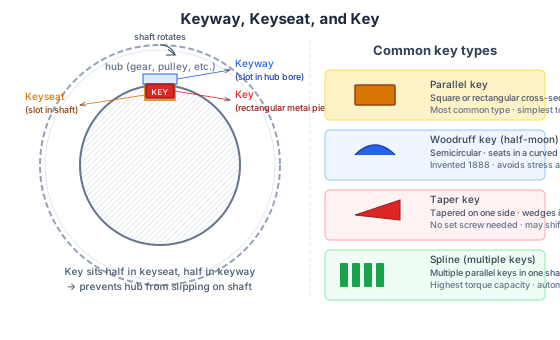
A keyway is a precisely machined slot — either in a shaft or in the bore of a gear, pulley, or coupling — designed to receive a small rectangular piece of metal called a key. The key sits half in the shaft’s slot and half in the hub’s slot, locking the two parts together so they rotate as one. A scratch, by contrast, is an accidental surface mark: shallow, irregular, and serving no mechanical purpose. From a distance, a keyway and a scratch can look similar — both appear as linear grooves on a metal surface — but one is an engineered feature held to thousandths-of-an-inch tolerances, and the other is damage. ScienceDirect defines a keyway as “a recess in a shaft or hub designed to receive a key, facilitating the prevention of relative movement between two parts.” A scratch facilitates nothing.
What a keyway actually does
The problem a keyway solves is simple: a gear or pulley pressed onto a smooth shaft will eventually slip under load. The friction between the two surfaces is not enough to transmit torque reliably, especially under vibration or reversing loads. A keyway-and-key combination creates a positive mechanical interlock. The key — a small rectangular block of metal — sits in matching slots in both the shaft and the hub. When the shaft rotates, the key transmits the force directly to the hub wall, and the hub turns with the shaft. Wikipedia’s article on machine keys states this clearly: “The key prevents relative rotation between the two parts and enables torque transmission.”
The whole system — shaft, key, and hub — is called a keyed joint. It is one of the oldest and most widespread methods of connecting rotating components, found in everything from bicycle cranksets to industrial gearboxes to car engines.
Keyseat vs. keyway: the terminology trap
This is where the vocabulary gets precise, and where most people get confused. Technically, the two slots are not the same thing:
- Keyseat — the slot machined into the shaft (an external feature on the shaft’s surface).
- Keyway — the slot machined into the bore of the hub (an internal feature inside the gear, pulley, or coupling).
National Machine Tool’s guide explains: “The key sits half in the keyseat (on the shaft) and half in the keyway (in the bore), which is what prevents the hub from rotating independently of the shaft.” In everyday shop usage, “keyway” is commonly applied to both slots, and most machinists understand either term in context. But on engineering drawings and in precision work, using the correct term matters — because the shaft keyseat and hub keyway are machined differently, held to different tolerances, and require different tools.
The four main types of keys
Not all keys are the same, and the type of key determines the shape of the keyway:
Parallel key. The most common type. A rectangular or square block of metal that sits in matching rectangular slots in the shaft and hub. Square keys are used for smaller shafts; rectangular keys for shafts over about 6.5 inches in diameter. Simple, cheap, and widely standardised (ANSI B17.1 in the US, DIN 6885 in metric).
Woodruff key. A semicircular key — half a disc — that sits in a matching curved slot cut by a specialised Woodruff cutter. Wikipedia notes that William N. Woodruff of Hartford, Connecticut, invented this type and received the John Scott Medal from the Franklin Institute in 1888 for it. The advantage: the circular profile self-centres in the slot, and a stuck key can be knocked out with a hammer blow (the curve pushes it out), unlike a parallel key that must be slid axially. Woodruff keys are common in machine tools, automotive applications, and marine propellers.
Taper key. Tapered on one side, it wedges into a matching tapered keyway in the hub. The wedge action locks the key in place without a set screw. The trade-off: the taper can push the hub slightly off-centre on the shaft, which matters in high-speed applications.
Spline. Multiple parallel keys cut directly into the shaft as a series of ridges. Splines transmit the highest torque and are used in automotive transmissions, aerospace, and heavy machinery. Wikipedia describes splines as “multiple keyways in the hub to transmit high power.”
How keyways are machined
Machining a keyseat (on the shaft) is straightforward: a standard end mill or keyseat cutter runs along the shaft surface, cutting a rectangular slot. The tool has full access to the shaft, so this is a standard milling operation.
Machining a keyway (inside a hub bore) is harder, because the tool must enter the enclosed space. National Machine Tool lists four methods: broaching (a multi-tooth tool pushed through the bore in one stroke — fast and accurate for through-holes), keyseat milling (a rotating cutter guided by the bore wall — works for blind bores), wire EDM (electrical spark erosion — slow and expensive, used for hard materials or unusual geometry), and slotting/shaping (a reciprocating single-point tool — slower but capable in blind bores). The tolerance on an internal keyway is typically ±0.0002 inches on width for precision applications — because any looseness lets the key rock under cyclic loading, which accelerates wear and eventually ruins the slot.
Why a scratch is not a keyway
A scratch on a shaft or gear bore is accidental damage — from handling, from a dropped tool, from debris in a bearing. It is shallow, irregular, and has no defined width, depth, or position tolerance. A keyway, by contrast, is machined to precise dimensions: a specific width matching the key, a specific depth (typically half the key height on the shaft side and half on the hub side), and a specific length and angular position. The distinction matters because:
- A scratch weakens the surface without providing any mechanical benefit.
- A keyway is an engineered feature that transmits torque.
- A scratch can be polished out (if shallow); a keyway must never be filled or filed.
- If you see a linear groove on a shaft and are not sure whether it is a keyway or damage, check whether it is straight, uniform in width, and located where a gear or pulley would mount. If it is, it is almost certainly a keyway. If it is irregular, shallow, and in an unexpected location, it is damage.
A short history
The keyed joint is ancient. The concept of inserting a wedge or block to lock two rotating parts together appears in early mill and waterwheel construction. The modern standardised key and keyway emerged with the Industrial Revolution, as interchangeable parts and standardised dimensions became essential for mass production. William Woodruff’s 1888 invention of the half-moon key was a significant refinement, solving the stress-concentration problem at shaft shoulders. Today, keyed joints coexist with newer methods — splines, interference fits, and locking adhesives — but the simple parallel key in a machined keyway remains the most common way to connect a gear to a shaft in industrial machinery worldwide.
Common misconceptions
“A keyway is the same as a keyseat.” Technically no — a keyway is in the hub bore, a keyseat is on the shaft. In practice, the terms are used interchangeably, and the distinction only matters in precision specifications.
“Any groove on a shaft is a keyway.” No. A scratch, a wear mark, or a machining artefact is not a keyway. A keyway has defined dimensions, a specific location, and is machined to tolerance.
“Keys are the strongest way to connect a shaft and hub.” Keys are simple and effective, but splines transmit more torque, and interference (press) fits eliminate the stress concentration that keyways introduce. Each method has its place.
“A Woodruff key is always better than a parallel key.” Woodruff keys self-centre and are easier to remove, but they are limited to smaller shafts (under about 2.5 inches in diameter) and are more complex to machine. Parallel keys are simpler, cheaper, and standard for larger shafts.
This entry is part of the fasteners & closures category. For how this site checks claims like these, see the method page, and for more hardware vocabulary, try the glossary.
The terminology, standards, and history claims in this entry were checked against the cited references on 18 August 2026. Corrections are welcome through the contact page.
Sources
- National Machine Tool — Keyway vs. Keyseat: What's the Difference?accessed 2026-08-18
- Wikipedia — Key (engineering)accessed 2026-08-18
- ScienceDirect — Keywaysaccessed 2026-08-18
Related entries
What Is a Split Pin?
A split pin is a cheap, disposable fastener with two tines that you bend apart after insertion to lock a nut, bolt, or clevis pin in place.
Why Some Screws Have an Unthreaded Shank
The smooth section under a screw head is not an accident. It lets the head pull two parts together, keeps the fastener cool while driving, and carries shear loads.
Spotted a mistake? Tell us about it and we will correct the entry.