What Is a Split Pin?
By Object Index Editorial TeamPublished Last reviewed
- Common name
- What Is a Split Pin?
- Category
- Fasteners & Closures
- Also called
- cotter pin, cotter key, split cotter
- Typical materials
- mild steel, stainless steel, brass, aluminium
- What it does
- A split pin passes through a hole in a bolt or shaft and is bent open, creating a physical barrier that prevents the nut or pin from vibrating loose.
- Last reviewed
- 2026-08-18
Direct answer
A split pin — also called a cotter pin in the US and UK, or a cotter key — is a simple metal fastener with two tines (prongs) that you bend apart after pushing it through a hole. Once the tines are splayed, the pin cannot pull back out, and whatever it was holding stays put. It is one of the cheapest and most universal locking fasteners in existence: you will find it on car suspension joints, bicycle axles, agricultural machinery, watchband links, and even the cap badges on military headwear. The trade-off for its simplicity is that a split pin is designed to be disposable — each time you remove one, you should throw it away and install a new one.
What to call it
The vocabulary around this fastener is a tangle, and the confusion matters if you are ordering parts. In the UK the traditional name is split pin, and the word “cotter” historically meant a separate wedge-shaped pin used on bicycle cranks and steam engines. In the US, “cotter pin” is the standard term for the split type, and “cotter key” is an older synonym still found in some industries. Wikipedia notes that to avoid the ambiguity, some engineers use split cotter when they mean specifically the two-tined bent type. Design World’s overview adds that the label “cotter pin” has been stretched to cover at least four different shapes: the traditional split pin, the R-clip (hairpin cotter), the split ring (circle cotter), and the tapered wedge cotter used on cranks. If someone hands you a split pin, you are holding the most common variant: a half-round wire folded in two.
How it is made
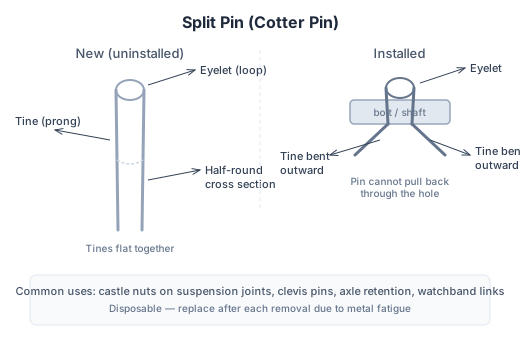
A new split pin is a piece of wire with a half-circular cross section, folded nearly in half so that its two flat inner faces touch for most of their length. From the outside it looks like a narrow cylinder with a small loop — the eyelet — at the folded end. The eyelet is the head that stops the pin from passing all the way through the hole. The two tines may be cut square, or one may be slightly longer (extended prong) to make them easier to separate during installation. Wikipedia’s cross-section diagram shows this clearly: two semicircles pressed together, forming what appears to be a solid round pin until you look at the tip and see the split.
How it works
The mechanism is pure mechanical interference. You insert the pin through a pre-drilled hole in a bolt, shaft, or clevis pin — typically through a castle nut (castellated nut) whose slots align with the hole. Once the eyelet is seated against one side, you use pliers to bend the two tines outward in opposite directions. The splayed tines now extend beyond the diameter of the hole, so the pin physically cannot retract. Fastenere describes the result as a locking mechanism that “essentially eliminates the risk of a nut coming loose, except in a case where the force applied is enough to shear through the pin.” That is the point: the pin does not resist rotation (a lock washer does that); it resists axial movement — it keeps the nut from walking off the bolt.
Where you see them
The most familiar place is the front suspension of a car. Ball joints, tie rod ends, and castle nuts on steering components all use split pins because the consequences of those fasteners loosening are severe. Reid Supply’s guide notes that the automotive, aerospace, and marine industries are the heaviest users, precisely because those environments involve high vibration and the cost of failure is high. On a smaller scale, split pins hold watchband links together, secure hinges on light gates, and appear on agricultural implements where a quick, cheap retainer is needed and vibration is constant.
The disposable rule
This is the single most important practical fact about split pins: do not reuse them. When you bend a split pin during installation, the metal undergoes plastic deformation. Bending it back straight to remove it, and then bending it again, work-hardens the tines and makes them brittle. Fastenere states this plainly: once removed, split pins should be discarded and replaced. A reused split pin is significantly more likely to snap under vibration than a fresh one. The pin costs almost nothing; the consequence of it failing on a suspension joint is not cheap at all.
Sizes and materials
Split pins are standardised by nominal diameter, which corresponds to the bolt size they are intended to retain. Wikipedia’s metric table lists sizes from 1.5 mm (for M6 bolts) up to 8 mm (for M48 bolts); American sizes range from 1⁄32 inch to ¾ inch. The pin must match the drilled hole: a pin that is too small will rattle, and one that is too large will not fit. Common materials are mild steel (cheapest, zinc-plated for corrosion resistance), stainless steel (for marine and food environments), brass, and aluminium. The softer the metal, the easier the pin is to bend — which is exactly the property you want in a fastener whose installation method is “bend it open with pliers.”
Variants worth knowing
Several fasteners live under the “cotter” umbrella, and it helps to recognise them:
- R-clip (hairpin cotter). A spring-steel pin with one straight leg and one curved leg. The straight leg goes through a hole; the curved leg clips around the outside of the shaft. Unlike a split pin, it is reusable and tool-free to install and remove.
- Hammer-lock split pin. Installed by striking the head with a hammer, which forces the shorter tine forward and spreads the pin. Used where a tighter fit is needed.
- Taper cotter. The original “cotter” — a wedge driven into a hole to lock a crank to a shaft. This is the type that gives the whole family its name, and it has been largely replaced by splines and keyways.
- Split ring (circle cotter). A wire loop that extends past 360 degrees, threaded through a hole. Key rings are the most common example.
Design World’s classification piece draws a clear line: if it is a wedge driven into a hole, it is a traditional cotter; if it is two tines bent apart, it is a split pin; if it is a sprung clip, it is an R-clip. All three are “cotter pins” in loose usage, but the split pin is by far the most common in everyday hardware.
A short history
The cotter pin was invented by Ira J. Young of the Wire Manufacturing Company in St. Louis, Missouri, in 1912. He filed two patents that year for machines to mass-produce the fastener (US patents 1,106,484 and 1,119,211, both assigned to Western Wire Products Company). Before Young’s invention, the “cotter” was a solid wedge used in steam engines and bicycle cranks — a different shape entirely. The split pin’s advantage was that it could be stamped from wire in a single operation, making it cheap enough to treat as disposable. That economic fact is what made it universal: a fastener you throw away after one use has to be almost free, and the split pin achieved that.
Common misconceptions
“A split pin is the same as a cotter pin.” In everyday usage, yes — most people use the terms interchangeably. But technically, “cotter pin” is a broader category that includes R-clips, tapered cotters, and split rings. The split pin is one type of cotter pin, not the whole family.
“Split pins are structural.” They are not. A split pin is a retainer, not a load-bearing fastener. It prevents axial movement; it does not resist shear forces in any meaningful way. If you need something to hold weight, use a bolt rated for the load.
“You can bend a split pin back and reuse it.” You can, but you should not. The metal fatigues with each bend, and a reused pin is far more likely to snap. Replace it every time — they cost fractions of a cent.
“Any pin through a hole is a split pin.” A clevis pin is a smooth, solid pin that goes through a hole, but it has no tines to bend. A roll pin is a hollow, spring-loaded pin that grips by friction. Neither is a split pin, though all three may appear in the same assembly.
This entry is part of the fasteners & closures category. For how this site checks claims like these, see the method page, and for related hardware vocabulary, try the glossary.
The terminology, history, and application claims in this entry were checked against the cited references on 18 August 2026. Corrections are welcome through the contact page.
Sources
- Wikipedia — Split pinaccessed 2026-08-18
- Fastenere — Cotter Pins: What Are Cotter Pins Used for?accessed 2026-08-18
- Reid Supply — What Are Cotter Pinsaccessed 2026-08-18
- Design World — What are cotter pins?accessed 2026-08-18
Related entries
Why Door Hinges Have Removable Pins
Most interior doors hang on loose-pin butt hinges: lift the pin and the door comes off the frame without a single screw being turned.
Why Some Screws Have an Unthreaded Shank
The smooth section under a screw head is not an accident. It lets the head pull two parts together, keeps the fastener cool while driving, and carries shear loads.
Spotted a mistake? Tell us about it and we will correct the entry.