What a Wall Anchor Actually Does
By Object Index Editorial TeamPublished Last reviewed
- Common name
- What a Wall Anchor Actually Does
- Category
- Home & Repair
- Also called
- drywall anchor, hollow wall anchor, wall plug, rawlplug
- Typical materials
- plastic (nylon or polypropylene), zinc-plated steel, stainless steel
- What it does
- A wall anchor expands behind or within a wall surface to distribute a screw's load over a larger area, preventing the screw from pulling out of soft or hollow material.
- Last reviewed
- 2026-08-18
Direct answer
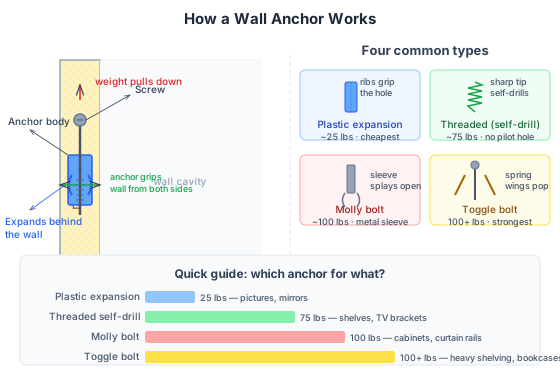
A wall anchor solves a simple problem: a screw by itself cannot grip drywall. Drywall is gypsum powder sandwiched between two sheets of paper — soft, crumbly, and unable to hold a thread under load. A wall anchor fixes this by expanding behind or within the wall surface, creating a much larger contact area that distributes the force. Instead of the screw’s threads bearing all the load against a few millimetres of gypsum, the expanded anchor pushes against a wide patch of the wall’s back surface. The result is a mount that can hold anywhere from 25 to over 100 pounds, depending on the anchor type.
Why screws alone fail in drywall
Try driving a screw directly into drywall and hanging a picture on it. It will hold for a few hours, maybe a day, and then the screw works loose as the gypsum crumbles around the threads. Bob Vila’s guide puts it bluntly: “Trying to screw directly into drywall without using any type of drywall anchor is not a good idea. Either the screw will pull straight back out or it will work loose after a few days.” The gypsum has no structural strength to resist the pulling force. Even if the screw does not pull out immediately, vibration and the weight of the object will gradually enlarge the hole until failure. A wall anchor prevents this by giving the screw something solid to push against.
The four main types
Wall anchors are not all the same. Each type trades off strength, ease of installation, and removability. The four most common families are:
1. Plastic expansion anchors
The cheapest and most common. A ribbed plastic sleeve is pushed into a pre-drilled hole. When the screw is driven in, the sleeve splits and expands, pressing against the sides of the hole. They are rated for about 25 pounds and are fine for pictures, mirrors, and small shelves. Bob Vila notes they can also be used in brick and cinder block, not just drywall. Installation is simple: drill, push in, screw. Removal is easy too — pull the screw with pliers and the anchor comes with it.
2. Threaded (self-drilling) anchors
These have a sharp tip and external threads that cut directly into drywall, so no pilot hole is needed. They are harder than plastic expansion anchors and grip better, with ratings up to 75 pounds. Some models split like expansion anchors for extra grip. The trade-off is that over-tightening can strip the drywall and loosen the hold. Picture Hang Solutions recommends using them for medium-weight items like shelves and curtain rods.
3. Molly bolts
A molly bolt is a metal sleeve with a bolt through it. You drill a hole, push the sleeve through, and tighten the bolt. As you tighten, the back of the sleeve expands and flattens against the inside of the wall, spreading the load over a wide area. Bob Vila rates them for up to 100 pounds. The expanded sleeve also makes them suitable for ceiling mounting, where plastic anchors might pull free. The downside: molly bolts are difficult to remove. You either cut around the sleeve (making a larger hole) or push it through into the cavity.
4. Toggle bolts
The strongest option. A toggle bolt has a screw with spring-loaded wings. You push the wings through a drilled hole, and they snap open behind the wall. The open wings distribute the load across a large area, giving toggle bolts ratings of 100 pounds or more. The catch is installation: you must thread the bolt through the object being mounted before inserting it into the wall, and once the wings are open, they cannot be closed — the only removal method is pushing the entire bolt through into the cavity. Bob Vila describes them as “among the strongest drywall anchors available.”
Choosing the right one
The decision comes down to two questions: how much weight, and can you hit a stud? If you can screw into a wall stud (the vertical wooden frame behind the drywall), you do not need an anchor at all — a screw into a stud can hold far more than any anchor. Picture Hang Solutions’ guide recommends checking for studs first. If a stud is not where you need it, match the anchor to the load:
| Weight | Best anchor |
|---|---|
| Under 25 lbs | Plastic expansion |
| 25–75 lbs | Threaded self-drill |
| 75–100 lbs | Molly bolt |
| Over 100 lbs | Toggle bolt |
Also consider the wall type. Drywall and plaster are the most common interior surfaces in North America and the UK. Masonry walls (brick, concrete, stone) require different anchors entirely — typically expansion bolts or sleeve anchors that grip by friction against the hard surface rather than by spreading behind it.
A note on wall types
If you are not sure what your wall is made of, knock on it. A hollow sound means drywall or plaster over a cavity. A solid thud means masonry. Picture Hang Solutions suggests this simple test. The distinction matters because the anchor you choose must match the substrate. A plastic expansion anchor that works perfectly in drywall will be useless in solid concrete, and a masonry sleeve anchor will be overkill and potentially damaging in thin plasterboard.
The original wall plug
The wall anchor is not a modern invention. The concept dates to the early 20th century, when the British company Rawlplug (a contraction of “Rawl” + “plug”) began manufacturing expansion plugs for fixing into masonry. The original Rawlplug was a wooden dowel driven into a drilled hole — the screw would expand the wood against the masonry. The transition to plastic came later, as injection-moulded nylon and polypropylene proved cheaper, more consistent, and resistant to rot. The word “rawlplug” is still used generically in British English for any wall anchor, much as “sellotape” means adhesive tape.
Common misconceptions
“Any anchor works for any wall.” No. A plastic expansion anchor in solid concrete will not grip at all. A masonry sleeve anchor in thin drywall will crack the board. Always match the anchor to the wall material.
“More anchors = more strength.” Not linearly. Two plastic anchors do not double the weight capacity — they share the load, but the failure mode shifts to the drywall itself crumbling between the holes. For heavier loads, use a stronger anchor type rather than adding more weak ones.
“You can reuse wall anchors.” Plastic expansion anchors can sometimes be reused once. Molly bolts and toggle bolts are essentially permanent — removal requires destroying the anchor or pushing it through the wall. Threaded anchors can be backed out and reinserted, but the hole is weakened each time.
“Anchors make the wall as strong as a stud.” They do not. A screw into a stud can hold 200+ pounds. The best toggle bolt in drywall holds around 100. Anchors are a practical compromise, not a structural equivalent.
This entry is part of the home & repair category. For how this site checks claims like these, see the method page, and for more hardware vocabulary, try the glossary.
The types, weight ratings, and installation claims in this entry were checked against the cited references on 18 August 2026. Corrections are welcome through the contact page.
Sources
- Bob Vila — 7 Types of Drywall Anchors Every Homeowner Should Knowaccessed 2026-08-18
- Picture Hang Solutions — How to Use Wall Anchors: A Beginner's Guideaccessed 2026-08-18
- Lowe's — Choosing Drywall Anchors: Types & Usesaccessed 2026-08-18
Related entries
Why Some Screws Have an Unthreaded Shank
The smooth section under a screw head is not an accident. It lets the head pull two parts together, keeps the fastener cool while driving, and carries shear loads.
Why Door Hinges Have Removable Pins
Most interior doors hang on loose-pin butt hinges: lift the pin and the door comes off the frame without a single screw being turned.
Spotted a mistake? Tell us about it and we will correct the entry.